This is an interesting site about science fiction works... that are about science fiction. (Spotted at Tim R. Mortiss' blog, La Explanada de Avente.)
Monday, July 30, 2007

Sunday, July 29, 2007
Polygamy
In societies where rich men are much richer than poor men, women (and their children) are better off sharing the few wealthy men; one-half, one-quarter, or even one-tenth of a wealthy man is still better than an entire poor man. As George Bernard Shaw puts it, "The maternal instinct leads a woman to prefer a tenth share in a first-rate man to the exclusive possession of a third-rate one."
(Psychology Today: Ten Politically Incorrect Truths About Human Nature)
In some instances concubines had wider latitude to act in their own interests than they might have had in poor marriages. An Icelandic folk saying of uncertain age goes, "Better a good man's frilla [a kind of concubine] than married badly."
(Jesse Byock: Viking Age Iceland)
Since some icelanders had more than one woman, others must have felt very cold indeed, alone in bed during those icy icelandic nights. The disadvantages of polygamy for non-elite males should be evident to anyone who was taught New Math at school:
 Non-injective and non-surjective: BAD (unless you are lucky A, that is)

Bijective: kind of OK for everybody I guess. Surely better than this.
Nineteenth Century LOLCats
London is peculiarly fertile in this sort of phrases, which spring up suddenly, no one knows exactly in what spot, and pervade the whole population in a few hours, no one knows how. Many years ago the favourite phrase (for, though but a monosyllable, it was a phrase in itself) was Quoz. This odd word took the fancy of the multitude in an extraordinary degree, and very soon acquired an almost boundless meaning. When vulgar wit wished to mark its incredulity and raise a laugh at the same time, there was no resource so sure as this popular piece of slang. When a man was asked a favour which he did not choose to grant, he marked his sense of the suitor's unparalleled presumption by exclaiming Quoz! When a mischievous urchin wished to annoy a passenger, and create mirth for his chums, he looked him in the face, and cried out Quoz! and the exclamation never failed in its object. When a disputant was desirous of throwing a doubt upon the veracity of his opponent, and getting summarily rid of an argument which he could not overturn, he uttered the word Quoz, with a contemptuous curl of his lip and an impatient shrug of his shoulders. The universal monosyllable conveyed all his meaning, and not only told his opponent that he lied, but that he erred egregiously if he thought that any one was such a nincompoop as to believe him. Every alehouse resounded with Quoz; every street corner was noisy with it, and every wall for miles around was chalked with it.
But, like all other earthly things, Quoz had its season, and passed away as suddenly as it arose, never again to be the pet and the idol of the populace. A new claimant drove it from its place, and held undisputed sway till, in its turn, it was hurled from its pre-eminence, and a successor appointed in its stead.
(Charles Mackay: Extraordinary Popular Delusions and the Madness of Crowds)
Saturday, July 28, 2007
They break; you can see through them
Six months did Thomas remain confined to his bed; and during that time he not only became reduced to a skeleton, but seemed also to have lost the use of his faculties. Every remedy that could be thought of was tried in his behalf; but although the physicians succeeded in curing the physical malady, they could not remove that of the mind; so that when he was at last pronounced cured, he was still afflicted with the strangest madness that was ever heard of among the many kinds by which humanity has been assailed. The unhappy man imagined that he was entirely made of glass; and, possessed with this idea, when any one approached him he would utter the most terrible outcries, begging and beseeching them not to come near him, or they would assuredly break him to pieces, as he was not like other men but entirely of glass from head to foot.
(Miguel de Cervantes: The Licenciate Vidriera. See also this post on Claw of the Conciliator.)
The bank had been modernized. It was a transparent young lady who waited on him. It wouldn't have startled him in any of the other worlds, but it did at home.
"I am unsure," he said. "Are you people?"
"I also am unsure," said the young lady, "since our position is presently under litigation. Actually we are the newest thing in people. Soon there will be none produced in the old manner. You will have to admit that it was a very grotesque arrangement."
(R. A. Lafferty: Space Chantey)
Plants and minerals, seas and athmospheric vapors here enjoy an absolute transparecy. Only the humans and higher animals stand out clearly above that whole by the opaline transparency of their bodies. Only their eyes, constructed like ours, are of an entirely opaque white. The muscles of that human race have the appereance of fibrous fasciculus, or amianthus. The blood which flows through their arteries is similar to lymph; the veinous blood seems to be of chyle or milk.
Despite a complexion offering in all its parts the vitreous appearance of a milky opal, the men of Élier are large, agile, and well proportioned. The women, a little smaller, are delicate and slightly diaphanous.
(C. I. Defontenay: Star)
The first symptom is a scaliness of the skin; itch, flakes upon the clothing, inflammation. There follows a weakness in the bones as the calcium is dissolved. One grows limp and rubbery, but this is still an early phase. Soon the outer tissues harden. Thick, opaque membranes form on the surface of the eyes; the nostrils may close and seal; the skin grows coarse and pebbled. In this phase prophecy is common. The sufferer partakes of the skills of a Somnambulist, and utters oracles. The soul may wander, separating from the body for hours at a time, although the life-processes continue. Next, within twenty days after the onset of the disease, the crystallization occurs. While the skeletal structure dissolves, the skin splits and cracks, forming shining crystals in rigid geometrical patterns. The victim is quite beautiful at this time and takes on the appearance of a replica of himself in precious gems. The crystals glow with rich inner lights, violet and green and red; their sharp facets adopt new alignments from hour to hour; the slightest illumination in the room causes the sufferer to give off brilliant glittering reflections that dazzle and delight the eye.
(Robert Silverberg: Nightwings)
I suppose a quote from Ballard's The Crystal World would belong in this post, but I haven't read that book yet.
Friday, July 27, 2007
Wikipedia Religion Links Smorgasbord
Some pages I found interesting:
Mandaeism. One religion I didn't knew about. Yazidi. Another one.
Tondrakians. Christian heretics of medieval Armenia.
Beguines. A female religious movement of the Middle Ages.
Kuzari Principle. A proof of the existence of God, specially suited to the Jewish religion.
Donmeh. Purported descendants of the followers of Sabattai Zevi.
Also, one shouldn't rely too much on Wikipedia. Or blogs.
Wednesday, July 25, 2007
¿Está A Coruña preparada para una epidemia zombi?
Mucho me temo que no. El principal problema es el cuello de botella a la salida, que haría muy difícil la evacuación:

El tema no fue mencionado por ninguno de los partidos durante las recientes elecciones municipales. Una triste muestra de la indiferencia de los políticos por las verdaderas preocupaciones de los ciudadanos.
Quizás las mejor estrategia en caso de epidemia zombi sería atrincherarse en la Torre de Hércules. O mejor aún: en el depauperado Centro de Ocio del puerto (que ya tiene un aire post-apocalíptico, todo sea dicho). Víveres no faltarían, porque la mayor parte de los locales son de comidas. El problema es que, al contrario que en los centros comerciales estadounidenses (al menos los que salen en las películas), no existiría una tienda de armas de fuego que poder saquear para defenderse de las hordas zombi. Pero quizás la tienda de comics y demás frikadas tenga una katana de pega (posiblemente de Naruto). La gran cantidad de locales vacíos haría sencillo alojar a los supervivientes.
Alternativamente, podría montarse uno en la Arielita y confiar en que, como suele pasar, quede averiada a medio camino, felizmente inaccesible.
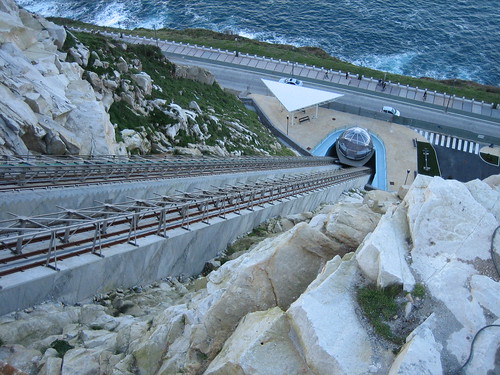
Si algún coruñés previsor ha concebido un plan mejor, estaría interesado en escucharlo.
Edit: Una ventaja del apocalipsis zombi sería que la eterna polémica A Coruña/La Coruña quedaría obsoleta al pasar la ciudad a denominarse "Zona de Infestación X-7013".
Monday, July 23, 2007
It kinda looks like NY

Another city rife with with towers is Sharn. It has the disadvantage of being imaginary. (Is Bologna real? I haven't been there so I can't tell.)
Sunday, July 22, 2007
Evangelistic Atheism
For a long time I have thought that modern evangelistic atheism (Dawkins, Hitchens, Dennet, et al.) is very close to the mindset of the early christians. Let's remember that those early christians were considered "atheists" by the pagans, and that they showed a pronounced skeptical streak. See the post The Original Atheists at Crooked Timber, and also the comments.
Going a little further back, Elijah's questioning of Baal's priests is almost scientific. He repeatedly asks for proof of their claims, derides them when that proof is not forthcoming, and then provides proof for the power of his own god. Some christians resent the snarkiness of the evangelistic atheists, but that snarkiness is nothing compared to that of Elijah (even without the ensuing massacre). Also, many of the arguments against idolatry in the Bible are pretty cogent and subscribable by modern atheists, who only carry them a little further. For the atheists, only Reason should be worshipped.
The book Black Mass by philosopher John Gray seems to make similar points, at least judging from the reviews.
Saturday, July 21, 2007
The Ethical Treatment of Books
Books are kept not on open shelves but in locked chests. Students who borrow are cautioned not to scratch grooves in the margin with their fingernails or to use straws from the lecture floor as placemarks. A Jewish ethical treatise warns that a man must not express his anger by pounding on a book or by hitting people with it. The angry teacher must not hit the bad student with a book, nor should the student use a book to ward off blows.
(Joseph and Frances Gies: Life in a Medieval City)
Friday, July 20, 2007
Used books from overseas
When buying used books from online bookstores, overseas shipping rates tend to end up surpassing the cost of the books themselves, frequently disuading me from the purchase.
BetterWorld.com delivers books to anywhere in the world for a mere $2.97, which is nice if you don't mind waiting a bit for your order (I don't). Some good deals there. They also sell through AbeBooks.
An excellent online bookstore for non-used books is The Book Depository. Free delivery, and the books tend to be cheaper than their Amazon equivalents once shipping is included.
Thursday, July 19, 2007
Hell is the absence of Blog
I post again, and sooner than forever!
Actually, the absence of Blog is not really Hell. It's more like a slight, liminal itch that you scratch by typing.
Saturday, June 23, 2007
Friday, June 22, 2007
Why...
..."filmed theatre" is a derogatory expression when applied to cinema, while "graphic novel" is supposed to dignify comic books?
Wednesday, June 20, 2007
Robert Aickman
“I found that I was thinking many deep thoughts. And then I noticed that a small tear was slowly falling down the Contessa's face. Without thinking, I sprang up; but then the Contessa smiled, and I sat down. One of my deep thoughts was that it is not so much particular disasters that make people cry, but something always there in life itself, something that a light falls on when we are trying to enjoy ourselves in the company of others.”
(Robert Aickman: Pages from a Young Girl's Journal)
Tuesday, June 19, 2007
Antinatural Aesthetics
The tribal disdain for nature extended into its active denigration of hair, agriculture, childbirth and even, perhaps, representational art.
In all of this the tribe was proclaiming that while its dominance derived from nature and was beyond question, its superiority meant that nature had no further claim on it. Everything else was created by the tribe itself, particularly the ornate and elaborate tattoos and paintings on members’ bodies.
(Edward Rothstein: Postmodern Thoughts, Illuminated by the Practices of a Premodern Tribe)
Silence was absolute, save for the purl of water under the hull. At night a pair of large moons cast a serene light through the foliage in a manner which Maihac found almost dreamlike in its effect. He said as much to Bariano, who responded with a condescending shrug. "I am surprised to find you so enthusiastic. It is, after all, a mere trick of nature." [...] "It is simply that your aesthetic judgments are amorphous. It is naive to detect beauty where none has been specifically intended. The subject is large. Often you will notice an agreeable aspect of nature, effected by random or mathematical processes. It may be serene and congenial, but it is the work of chance and lacks the human afflatus. There is no pulse of positive creativity to infuse it with true beauty."
(Jack Vance: Night Lamp)
Monday, June 18, 2007
Watch empires fall
I have been searching for software that provides the kind of information historical atlases do, but in animated form. The idea is to watch empires fall and frontiers fluctuate as years go by. Something like this flash animation of Middle East history, but more detailed and with some degree of user control over how the information is displayed.
I have found a commercial program called Centennia, which does just that:
CENTENNIA is a map-based guide to the history of Europe and the Middle East from the beginning of the 11th century to the present. It is a dynamic, animated historical atlas including over 9,000 border changes. The map controls evolve the map forward or backward in time bringing the static map to life. Our maps display every major war and territorial conflict displaying the status of each region at intervals of a tenth of a year. The maps reflect actual "power on the ground" rather than internationally-sanctioned or "recognized" borders.
You can download it and try it for free, although the trial version is circumscribed in time to the years between 1789 and 1819.
Then there's AtlasOfWorldHistory.com, which I haven't tried yet. Also, games like Europa Universalis may offer similar functionality, although it would be constrained to the level of detail of the gamemap.
Anyone knows of more programs like these?
Edit: I found another one, from the BBC.
Sunday, June 17, 2007
¿Qué es poesía? (2)
"¿Qué es poética? El arte de hacer coplas. ¿Qué son coplas? Unos montoncitos de líneas desiguales, llamadas versos. ¿Qué es un verso? Un número determinado de sílabas. ¿Qué dificultad ofrece su composición? Los consonantes. ¿Cómo se adquieren estos consonantes? Comprando un Rengifo por tres pesetas. ¿Qué otra cosa es necesaria además de esto para hacer cualquiera obra poética digna de la luz pública? Un poco de práctica, y otro poco de poca vergüenza."
(Leandro Fernández de Moratín: La derrota de los pedantes)
808.1 D543. Diaz Rengife, Juan. Arte poetica espanola, con una fertilissima silva de consonantes comunes, prepios, esdruxulos y reflexos, y una divino estimulo del amor de Dios. Madrid, 1644.
(de aquí)
Saturday, June 16, 2007
The Penis is Evil
"The penis is evil. The penis shoots seeds, and makes new life, and poisons the earth with a plague of men, as once it was. But the gun shoots death, and purifies the earth of the filth of brutals. Go forth and kill!" Why oh why there can't be more science fiction movies like Zardoz?
I think Borges would agree with Zardoz, about penises if not about guns. "Mirrors and copulation are abominable." Come to think of it, wasn't a long mirror scene of some kind in Zardoz?
Wikipedia has a list of fictional depictions of immortality, including Zardoz and Borges' The Immortal. But, no Jack Vance's To Live Forever!
A remake of Zardoz could tap into modern blue state / red state anxieties in the US. The problem is, where to find an actor as hairy as Connery? Because Zed must be hairy, to make him stand out from the effete, metrosexual immortals. And yet, I don't think Robin Williams would be good for the part.
Friday, June 15, 2007
El Lobo y el Cordero
Traduzco un pasaje de Gene Wolfe sobre Jesucristo. La cita original se puede encontrar en este artículo sobre Wolfe en First Things (recomiendo leer el original, porque mis habilidades de traductor no son para tirar cohetes.)
Wolfe es un católico con una teología un tanto particular. En una de sus entrevistas, menciona lo siguiente:
O sea, que Wolfe es un henoteísta, al menos en lo que respecta a los antiguos dioses olímpicos.
Todo lo anterior se refleja en su obra. El protagonista de El Libro del Sol Nuevo es una figura mesiánica, y un torturador de profesión (aunque esto último no se retrata de manera especialmente positiva). El Latro de Soldado de la Niebla es un mercenario romano utilizado como peón por los dioses griegos (su nombre es apropiado: "Latro" significa tanto "mercenario" como "peón" en latín). Y en El Libro del Sol Largo (del que sólo he leído el primer volumen), un sacerdote abandona progresivamente su culto politeísta para abrazar al dios "verdadero".
Ha sido dicho miles de veces que Cristo murió bajo tortura. Muchos the nosotros hemos leído tantas veces que él fue "un humilde carpintero" que sentimos un atisbo de náusea al ver esas palabras de nuevo. Pero nadie parece darse cuenta de que los instrumentos de tortura fueron madera, clavos, y martillo; que el hombre que construyó la Cruz fue indudablemente un carpintero también; que el hombre que clavó los clavos fue tanto un carpintero como un soldado, tanto un carpintero como un torturador. Muy pocos han percibido incluso que aunque Cristo fue un "humilde carpintero", el único objeto que se nos dice específicamente que contruyó no fue una mesa o una silla, sino un látigo.Y ya que estamos hablado del aspecto más, digamos, "severo" de Jesús, aprovecho para enlazar al post Did Christ Ever Laugh? de Laudator Temporis Acti.
Wolfe es un católico con una teología un tanto particular. En una de sus entrevistas, menciona lo siguiente:
Uno de los lugares donde me diferencio de la doctrina Católica convencional es en que creo que los dioses del paganismo eran reales. No creo que fuesen merecedores de la adoración que recibían de los paganos. Creo que lo que muchos de los autores bíblicos están diciendo es: "Sí, esos son poderes verdaderos, pero es equivocado que les des los honores que son debidos solamente a Dios." Y creo que eso es exactamente correcto.
O sea, que Wolfe es un henoteísta, al menos en lo que respecta a los antiguos dioses olímpicos.
Todo lo anterior se refleja en su obra. El protagonista de El Libro del Sol Nuevo es una figura mesiánica, y un torturador de profesión (aunque esto último no se retrata de manera especialmente positiva). El Latro de Soldado de la Niebla es un mercenario romano utilizado como peón por los dioses griegos (su nombre es apropiado: "Latro" significa tanto "mercenario" como "peón" en latín). Y en El Libro del Sol Largo (del que sólo he leído el primer volumen), un sacerdote abandona progresivamente su culto politeísta para abrazar al dios "verdadero".
Wednesday, June 13, 2007
Did you know...
...that there is such a thing as metametaphysics? (Spotted at David Chalmer's blog, fragments of consciousness)
Then there's Conscious Entities, a blog about the mystery of consciousness. The entry titled Strange ideas (or, "Dead ends") is especially informative, and amusing.
The post Should Ethicists Behave Better? Should Epistemologists Think More Rationally? at The Splintered Mind is also very interesting.
Edit: Here is a review of David Benatar's Better Never to Have Been. And here is more commentary on the book.
Subscribe to:
Posts (Atom)