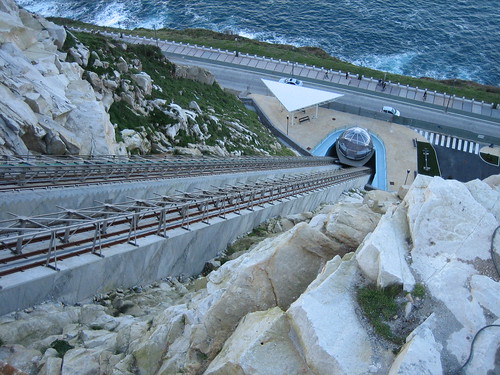
Saturday, September 22, 2007

Three empty seats

In the palace of Khusro I Anoshirwan at Ctesiphon [...] three empty seats stood beneath the royal throne. These were for the emperor of China, for the great khagan (the ruler of the nomads of central Asia), and for the Roman emperor, in case these rulers came, as vassals, to the court of the king of kings. The three thrones summed up the vast horizons of the Sassanian empire.

(Peter Brown: The World of Late Antiquity)

There's a pair of posts about sassanian stuff down at Zenobia, Empress of the East. And here is a history of the Sassanian empire on Project Gutenberg.

Speaking about Late Antiquity, Avram Davidson wrote a series of novels set in that time period, sprinkled with touches of fantasy and humor: the Peregrine books.

Friday, September 21, 2007

No son tantos los muertos

En este post de Edad de Oro se cita a Flannery O'Connor diciendo que "los muertos son un millón de veces más que los vivos".

La señorita O'Connor (o el personaje en cuya boca pone esas palabras) exagera un poco. En el número de Septiembre de Investigación y Ciencia, se comenta que en 2002 la población mundial representaba aproximadamente el 6% del total de la gente que haya nacido hasta esa fecha. O sea, que los muertos son sólo unas 17 veces más que los vivos. Más información, aquí.

Aún así, está claro que si los muertos votasen, ganarían siempre por mayoría absoluta. ¿Cuántas historias de fantasía habrán literalizado la frase de Chesterton de que la tradición es la "democracia de los muertos"?

Tuesday, September 18, 2007

Ozimandias en A Coruña

En general, lo nuevo -ya se trate de un objeto o de una idea- posee una cualidad abrasiva sumamente desagradable. Sólo una vez que sus aristas han sido pulidas por el roce del Tiempo, lo nuevo pasa a ser medianamente aceptable y podemos tolerar su presencia sin fruncir el ceño. (Ya sé que existen fetichistas de lo nuevo, pero pervertidos los hubo en todas las épocas.)

De ello se deduce que todo acto de creación es de mal gusto. Pero si uno, empujado por el orgullo o la imprudencia, se empeña en crear algo, ¿cómo hacerlo con la mayor delicadeza posible, para minimizar la irritación causada al tejido de nuestro cosmos exangüe? La solución obvia es hacer pasar lo nuevo por antiguo.

Así pues, tu radical e innovador movimiento político-social debe presentarse como la largamente demorada recuperación de alguna Edad de Oro situada en el pasado, real o imaginaria. Si eres arquitecto, que tus edificios semejen ruinas, y pasen a estar abandonados desde su misma inauguración. En ese aspecto, La Cidade da Cultura me parece injustamente denostada. Sospecho que, en el fondo, el estímulo cultural que se pretendía es el que las ruinas suscitan en la imaginación romántica.

Y si eres escultor, que tus novísimas estatuas parezcan provenir del saqueo de alguna capital antiquísima. Se diría que ésta es la aproximación de Igor Mitoraj, cuya obra puede contemplarse en la la plaza de María Pita:

(foto sacada de este artículo en Galicia-Hoxe.com)

Las figuras esculpidas por Mitoraj a veces parecen estar envueltas en sudarios o vendajes, lo que refuerza el efecto.

Edit: "El roce del Tiempo" (Time's rub) es el título de un relato de Gregory Benford sobre la entropía, la inmortalidad, la identidad, y la paradoja de Newcomb.

Monday, September 17, 2007

R. A. Lafferty on Lulu

Reading the message board of the R. A. Lafferty Devotional Page, I learnt that More Than Melchisedech, a very hard to find book by Lafferty, can now be bought from the print-on-demand company Lulu. Here is the link.

More Than Melchisedech appears to be tied in some manner with The Devil is Dead, one of Lafferty's "difficult" novels. This later book has the best preface (Lafferty uses the word "promantia") for a novel, ever. In it, we are promised many things, among them...

Given here, for the first time anywhere, are the bearings and correct location of the Terrestrial Paradise, down to the last second of longitude. You may follow them. You may go there.

(R. A. Lafferty: The Devil is Dead)

Is this the beginning of a trend, in which we see previously unavaliable works by Lafferty start surfacing? We can only hope.

Edit: Apparently, the word "promantia" means something like "the preferential right to consult an oracle."

Saturday, September 15, 2007

Academic conferences

It is common knowledge that there are two kinds of scholar these days: the stationary and the peripatetic. The stationaries pursue their studies in the traditional way, while their restless colleagues participate in every sort of international seminar and symposium imaginable. The scholar of this second type may be readily identified: in his lapel he wears a card bearing his name, rank, and home university, in his pocket sticks a flight schedule of arrivals and depatures, and the buckle of his belt -as well the snaps on his briefcase- are plastic, never metal, so as not to trigger unnecessarily the alarms of airport scanners that search boarding passengers for weapons. Our peripatetic scholar keeps up with the literature of his field by studying in buses, waiting rooms, planes, and hotel bars.

(Stanislaw Lem: The Futurological Congress [1971])

On the following day Laurz Mur called the conclave of xenologists to order. Standing on the speaker's podium, he swept the audience with an appraising eye. Five hundred xenologists came under his purview: every sort of philosopher, explorer, biologist, anthropologist, historian, cultural psychologist, linguist, analytical aesthetician, philologer, dendrologist, lexicographer, cartologist, and a dozen other more recondite professions. Some were scheduled speakers; others would listen and engage in the important work of intellectual cross-fertilization. Still others had brought papers they intended to read, if the opportunity offered, or even if not: somehow, by hook or by crook, the precious paper with its carefully honed phrases and engaging new ideas must be heard!

(Jack Vance: Night Lamp. By the way, "cartologist" seems to be a real word. Is it a mere synonym for "cartographer", or has it some particular shade of meaning?)

One possible way to enliven the closing ceremonies of academic conferences would be to arrange a "PowerPoint collage" by taking one slide from each of the transpired presentations, and then forcing one unfortunate attendant chosen at random to defend it as if it were his own paper. If he didn't make a convincing case, he would be erased from the proceedings. Fun for everyone, except one! (If the congress is about Moral Philosophy, the utilitarian guy should be chosen.)

Friday, September 07, 2007

No one around

If humanity suddenly dissapeared, for how long would traces of our existence remain? The World Without Us by Alan Weisman explores that question.

Poul Anderson's haunting short story "In Memoriam" does the same, in a more fictionalized form. It begins like this:

Against the inexorable forces of time, will humanity leave any lasting mark?

The last man on Earth knew not that he was. Nor would he have cared. He had met very few other humans in his life, and none since his woman coughed herself into silence.

Tuesday, September 04, 2007

Roleplaying in the Dying Earth

In the essay "Rules to Mock Your Vain Ambitions", noted RPG designer Robin D. Laws describes what were his aims when adapting Jack Vance's "Dying Earth" setting to a Role-Playing Game.

I find fascinating the discussion of how the game mechanics were carefully tailored to achieve a proper "Dying Earth" feeling during play. Besides design artistry, it required a deep knowlege of Vance's stories: the identification of their recurring themes, motifs, an character archetypes, not to mention an ear for his use of language (the players are encouraged to speak in the rarefied dialogue peculiar to the series, and the rules themselves are written "in voice".) It's no wonder then that the essay doubles as an interesting commentary on Vance's work.

The bit about the different dice "personalities" is amusing:

Maybe I'm crazy, but I've always found that the different dice used in RPGs all carry different emotional temperatures. The d4 is primal, parsimonious, and, as anyone who has ever stepped on one knows, hostile. The d12 is your goofy uncle, the one who tells you stories aren't supposed to hear and asks you to pull his finger. The d20 is a serious-minded juggernaut of decimal regularity. The six-sider, on the other hand, is a Dying Earth die all the way. A cube, it is elegant, spare, and classical. As the die used by normal civilians, the d6 offers a kind of bridge out from the world of RPGs, just as the Dying Earth stories straddle the boundaries between genre fiction and literature.

Monday, September 03, 2007

Léon Bloy lee a H. G. Wells

6 DE NOVIEMBRE. He acabado la nueva novela de Wells, Los primeros hombres en la Luna. Es un Julio Verne escritor, es decir, un monstruo. Ateísmo anglosajón. Este hombre da la sensación de que escribe desde el fondo de un pozo. De todos modos, como invención es un libro muy inferior a La guerra de los mundos, pero no tiene nada de la abominación capital, primigenia y transcendental de La isla del doctor Moreau, libro negro entre los atroces, donde hasta el propio Demonio parece salir difamado.

(Léon Bloy: Diarios. Editorial Acantilado.)

"abominación capital, primigenia y transcendental" tiene un aire a frase lovecraftiana...

Sunday, September 02, 2007

The Immortalists

In an earlier post, I mentioned Alexander Bogdanov's pursuit of immortality. Not fairytales like the persistence of the soul, or flimsy, metaphorical substitutes like enduring fame, but honest to God physical rejuvenation.

Turns out that, a few years after his death, he had counterparts in the US attempting the same thing. In both cases the plan was to bestow eternal life on a restricted elite: the party leadership in the case of Bogdanov, some kind of eugenic camarilla in the case of Lindbergh and Carrel.

Saturday, September 01, 2007

Pesadilla de un torero

Visto en CoverBrowser. En el sitio, aparte de infinidad de portadas de comics, se puede encontrar una interesante galería de las peores carátulas de discos.

Siento debilidad por las portadas de Heavy Metal y revistas afines. ¿Existe alguna página que recopile las de Zona 84?

Friday, August 31, 2007

Flatland

R. A. Lafferty didn't like modern society. He used the term "Flatland" (possibly inspired by Edwin Abbott's novel) to characterise a world which he he saw as unstructured and bereft of an spiritual dimension. Furthermore, Lafferty believed that the ability to remember the previous -more wholesome- state, and to perceive the degradation of the current one, was lost in the transition.

I am speaking literally about a real happening, the end of the world in which we lived till fairly recent years. The destruction or unstructuring of that world, which is still sometimes referred to as 'Western Civilization' or 'Modern Civilization', happened suddenly, some time in the half century between 1912 and 1962. That world, which was 'The World' for a few centuries, is gone. Though it ended quite recently, the amnesia concerning its ending is general. Several historiographers have given the opinion that these amnesias are features common to all 'ends of worlds'. Nobody now remembers our late world very clearly, and nobody will ever remember it clearly in the natural order of things. It can't be recollected because recollection is one of the things it took with it when it went...

(R. A. Lafferty: The Day After the World Ended. Collected in his essay volume It's Down the Slippery Cellar Stairs)

Maybe Lafferty selected the year 1962 as the "upper bound" of the End of the World because of Vatican II?

There is a vage memory that this late world had a large and intrincate superstructure on it, and that this came crashing down. There is some dispute as to whether we gained by the sweeping away of the trashy construction, or whether we lost a true and valid dimension in the unstructuring of our Old World, and wether we do not now live in "Flatland." There is no way to settle this dispute since the old structure cannot be recaptured or analyzed.

There is even some evidence that "Flatlands" are the more usual conditions, and that the worlds with heights and structures are the exceptions. Even if we could go back there, a Time Machine from Flatland and eyes from Flatland would not be able to see a dimension not contained in Flatland.

(ibid.)

The fourth (as yet unpublished) volume in Laffety's autobiographical series In a Green Tree is titled Incidents of Travel in Flatland. It covers the sixties and the seventies. I would love to take a look at it.

The idea that "it sucks, you just don't realize it sucks" is interesting, but the catch is that it can be used to argue that anything sucks. It's not that different from the approach taken by the Frankfurt school when they, too, tried to show that "it sucks". (Not that Lafferty would agree on anything with that bunch of pinkos, mind you.) On the other hand, "To see what is in front of one's nose needs a constant struggle".

This concern of Lafferty shows in many of his works, most of the time in a veiled manner. Which is probably good, because I suspect I wouldn't like his philosophy if he had made it completely explicit. Instead, we have his stories and novels.

Thursday, August 30, 2007

Predicando

Y Paul Le Jeune se quejaba en 1635 desde Nueva Francia porque un chamán local, viendo comprometida su propia reputación como sanador milagrero y hacedor de la lluvia, solía "divertirse a mis expensas, sugiriéndome palabras indecentes en su idioma [para que] tomase nota de ellas y asegurándome que no hay nada malo en las mismas, a fin de conseguir que yo pronuncie esas palabras soeces en presencia de los salvajes".

(Jonathan Wright: Los Jesuitas)

El episodio recuerda un poco al sketch "El diccionario de húngaro" de los Monty Phyton:

No es prudente aprender la lengua local precisamente de la persona a la que pretendes dejar sin trabajo, y que se encuentra comprensiblemente preocupada por tu intrusismo laboral. Me pregunto si serían posibles versiones más sofisticadas de la treta, por ejemplo: en vez de hacer decir palabrotas al pobre jesuita, construir cuidadosamente el "diccionario" de manera que lo que predique resulte herético para su propia doctrina.

Wednesday, August 29, 2007

First seen in science fiction?

The narrative device of having one character annotate a work written by another character, grossly misinterpreting it to suit his own cynical ends and/or delusional worldview, is most famously used in Nabokov's Pale Fire where, in fact, the anotations to an (intentionally) dreadful poem constitute the bulk of the novel. Gene Wolfe has mentioned his admiration for Pale Fire in one interview, and it's easy to see how the book influenced Wolfe's own oblique style and penchant for unreliable narrators.

A previous, more limited use of that device can be found Bernard Wolfe's Limbo, published ten years before Pale Fire. One section of the book consists in the old diaries of the main character, written amidst the horrors of World War III. In them, he expounds a demented program for achieving world peace that involves the mass voluntary amputation of limbs as a way to curb the aggresive instincts of the human race.

The plan was clearly intended as satire by the protagonist, in the "Irish people should eat their children" manner. However, a former colleage of his got hold of the diaries, and took them literally. In fact, he goes on to become the leader of a post-apocalyptic US on a pro-amputation platform. The diaries are published as a kind of seminal political manifesto, conveniently and obtusely annotated to justify a literal interpretation.

Are there other uses of the "misguided commentary" device that predate both Pale Fire and Limbo? Or is Limbo the first novel to feature it, even if it is circumscribed to one part of the book and does not overwhelm the "main" text?

Anyway, Wolfe's novel is unjustly forgotten, and worth a read despite its misogyny and overuse of freudian jargon. Some (not misguided!) commentary on the book here.

Tuesday, August 28, 2007

Impotencia selectiva

el 11 de mayo de 1453 el arcediano de Segovia, sede vacante a la sazón, leía un sentencia de divorcio por él pronunciada, declarando nulo en matrimonio entre Enrique y Blanca a los trece años de contraído. [...] La causa de nulidad alegada era la impotencia de Enrique, aunque sólo en relación con Blanca, puesto que el arcediano había recurrido al testimonio de ciertas mujeres públicas de Segovia, las cuales estaban dispuestas a jurar que, con ellas, había tenido "trato y conocimiento de hombre con mujer".

(Luis Suárez Fernández: Nobleza y Monarquía)

Sunday, August 26, 2007

Calabresas, Islandesas

Las mujeres tienen en la Ndrangheta un papel importante. [...] Las mujeres también son las que mantienen vivas las faidas, las venganzas, además de organizar matrimonios de conveniencia entre las familias amigas. "No os he criado para pagar las facturas de la luz y el agua", se escucha en una interceptación a Saveria Strangio, viuda de un capo, durante las escuchas que la policía realizó en la casa milanesa de uno de sus hijos.

(María Signo: El poder de la mafia calabresa. En La Voz de Galicia del Domingo 26 de Agosto)

"Cold are the councils of women" reads a famous line from Njáls Saga, and in times of feud women are repeatedly portrayed in the sagas as demanding blood vengeance. Demanding and getting are not the same, and the self-willed women of Njáls Saga at times found it difficult to goad their men into action.

(Jesse Byock: Viking Age Iceland)

"Bolli, your brother's killer, lives there. You have certanly turned out very different from your noble kinsmen if you don't want to avenge a brother like Kjartan. [...] It's a sad thing to have shirkers for sons. [...] Olaf's worst misfortune, that he was cheated when it came to the kind of sons he got."

(Laxdaela saga, quoted in Jesse Byock's Viking Age Iceland)

Saturday, August 25, 2007

Zibarro

I have just finished All-Star Superman #8 and enjoyed it a lot, especially the character Zibarro.

Despite superficial appearances and Zibarro's own proclamations, I think he is an opposite of Superman like regular Bizarro, only in subtler ways. He gives up easily while Superman perseveres, he despises the other bizarros while Superman -basically an alien god- loves and appreciates normal Earth people, and so on.

Finally (this might sound far-fetched, but let's remember that Morrison has a penchant for playing with the fourth wall) while Superman is a character in a story, Zibarro is himself an author of stories. At the end of the issue, he is tasked by Superman with writing the events that have just transpired! Maybe the whole issue has been written by Zibarro?

Thursday, August 23, 2007

Una nueva y excitante tecnología

El explorador de hipertexto no lee, no escucha, no ve televisión. El explorador de hipertexto navega en un vasto océano de información textual, sonora y visual, buscando sus propios caminos de conocimiento a medida que se adentra en niveles cada vez más profundos del libro absoluto.

(Muy Interesante, Especial Comunicación. Verano de 1990. 350 ptas.)

En el hipertexto, la información se organiza de la misma forma como lo hace la mente humana. Y el sistema de recuperación funciona de manera muy parecida al cerebro cuando quiere acceder a los datos almacenados en la memoria: por asociaciones de ideas y por el contexto en que se producen. [...] Sólo que en el hipertexto, en lugar de un desencadenante neuroquímico, como ocurre con los mecanismos de la memoria, utilizamos una herramienta electrónica: el ratón o la pantalla táctil.

(íbid.)

Para explicar estos conceptos, se usa como analogía el libro poliédrico. Imaginemos un libro en forma de cubo que se pueda abrir por cualquiera de sus seis caras. Cada una de ellas representa el comienzo de un camino distinto para recorrer el contenido de todo el libro. Se empiece por donde se empiece, al final hemos alcanzado toda la información, aunque por caminos diferentes. Los jóvenes lectores de novelas interactivas tal vez estén más preparados para comprenderlo. En el hipertexto, cada portadda del libro poliédrico -que no hace falta que tenga únicamente seis caras- simboliza un bucle de presentación a partir del cual parten, hacia dentro, decenas, centenares o miles de otros bucles interconectados. Y por ellos navega el lector-explorador.

(íbid.)

En el horizonte: la megapedia universal que reúna los archivos históricos de toda la humanidad. [...] Cualquier ciudadano, desde su propia casa, tendrá la oportunidad de conectar su terminal doméstico al gran conocedor, un superodenador central con billones y billones de fichas-bucle.

(íbid.)

Suena excitante, casi como un salto a un estado superior de conciencia. (Supongo que no se estará hablando de una simple evolución de las referencias, índices, y notas a pie de página de toda la vida, ¿no? Eso sería tan prosaico....)

Las "novelas interactivas" que leen los jóvenes supongo que serán aquellas de "elige tu propia aventura". Ah, tiempos...

Aprovecho para mencionar el excelente blog Paleo-Future, dedicado a cartografiar cómo era antes el porvenir.

Tuesday, August 21, 2007

"Glassy-eyed zest"

This blog post comments on a felicitous turn of phrase by Jack Vance: "spasm of zeal".

For my part, I want to mention another one I like very much: "glassy-eyed zest". It appears in the first chapter of The Green Pearl (freely avaliable here in PDF form for you to sample, dear reader.)

The expression is used in the context of some erotic exertions on the part of one of the characters, performed with a certain lack of genuine enthusiasm.

Monday, August 20, 2007

Dead Brothers

Dick’s early history is at once tormented, hustling, and oddly lit by the bright California sunshine of the late fifties. Born in 1928, he had a twin, a sister named Jane, who died when she was only a month old; like Elvis Presley, who also had a twin sibling who died, Dick seems to have been haunted for the rest of his life by his missing Other.

(Adam Gopnik: Blows Against the Empire)

Another insane/weird genius haunted by a lost brother (although not a twin) was Salvador Dalí:

When he was five, Dalí was taken to his brother's grave and told by his parents that he was his brother's reincarnation,[8] which he came to believe.[9] Of his brother, Dalí said: "… [we] resembled each other like two drops of water, but we had different reflections."[10] He "was probably a first version of myself but conceived too much in the absolute."[11]

(Wikipedia entry on Salvador Dalí)

Sunday, August 19, 2007

Calle Amargura

A ver si alguien más puesto que yo en toponimia urbana me puede resolver la siguiente duda...

Existe una Calle Amargura en el casco viejo de A Coruña. En ella se encuentra una librería de segunda mano que suelo frecuentar.

Hay calles con el mismo nombre en Pontevedra, Sevilla, y Cáceres. Para la de esta última ciudad, al parecer existe una leyenda que atribuye el origen del nombre a ciertos eventos trágicos que sucedieron en ella. Pero entonces, ¿cómo se explica que otras calles en otras ciudades se llamen igual? ¿Cuál es el verdadero origen del nombre?

Edit: También hay una Calle Amargura en Tarifa. Y en Málaga.

Edit#2: Y en este otro sitio.

Edit#3: Resulta que existe una Virgen de la Amargura. Más información, aquí. Imágenes, aquí. ¿Relacionado?

"Al agote garrotazo en el cogote"

Nunca había oído hablar de este grupo étnico.

Inhumanity makes us human

Inhumanity, n. One of the signal and characteristic qualities of humanity.

(Ambrose Bierce: The Devil's Dictionary)

I posit a theory: the privileged being which we call human is distinguished from other animals only by certain double-edged manifestations which in charity we can only call "inhuman."

(R. A. Lafferty: Arrive at Easterwine)

Saturday, August 18, 2007

A barrage of divine truths

Like the Marinids, the Mamluks, and other crude conquerors fresh from the steppe, the Ilkhans were quick to surrender to the sophisticathed civilization that enveloped them. Indeed the mind of the Mongol warrior was so culturally deprived that it presented a vast blank on which all sorts of refined and humane influences could be written.

(Ross E. Dunn: The Adventures of Ibn Battuta)

Genghis had set a policy of toleration for all religions within the empire, and ultimately the formless tribal shamanism to which he remained loyal withered under a barrage of divine truths which missionaries of all the world-universalist faiths fired at his various successors.

(íbid.)

Friday, August 17, 2007

Oh Lord, give me chastity, but do not give it yet

The Principle of Diachronic Integrity

Profundando

Era un barbeiro de sábado que amaba os libros que non entendía e gustaba de lélos todos enteiros. Unha vez atopéino coa testa pousada nas mans, ó xeito dun pensador, e díxome:

- Estou profundando.

(Castelao: Cousas)

Un día pousóu os ollos no mar -endexamáis reparaba en cousas miúdas- e dispóis de ter profundado un bo retrinco de tempo deitóu na orella do seu compañeiro ísta frase:

- O mar ¿sabes? O mar... ¡é un fenómeno!

(íbid.)

Simpatizo con el barbero, a pesar del retrato satírico que de él hace Castelao. ¿Qué tiene de reprobable, o de risible, entrar en comunión con el misterio numinoso del océano?

Friday, August 03, 2007

I knew it

From here:

"There's a lot of hype around the alleged harm that people do to themselves" with enhancements, Hughes says. "But in head-pounding sports, you face a lifetime of disability. In soccer, heading the ball often enough lowers your IQ".

Myself, I have always been wary of heading the ball. I surmised the practice wasn't doing any favors to my beleaguered neurons. Thank God I no longer play that brutish sport.

SFnal Titles

I think it was Samuel R. Delany who said that science fiction is better understood as way of reading than as a property of the texts themselves. For example, consider the sentence: "Her world exploded". It could simply refer to a woman undergoing psychological trauma, or... to an actual planet exploding (I suppose the woman in question would suffer psychological trauma in that case too). See here.

It also happens with titles. In fact, some mainstream book titles would be perfect for science fiction novels! I have no idea what A Thousand Splendid Suns is really about, but to me it conjures visions of an epic voyage of space exploration.

In Search of Lost Time? What better title for a time-travel story?

One Hundred Years of Solitude is obviously the tale of posthuman astronaut marooned on an unhabited planet.

And, of course, there's Invisible Man:

Mr. Ellison said, ''Once the book was done, it was suggested that the title would be confused with H.G. Wells's old novel, 'The Invisible Man,' but I fought to keep my title because that's what the book was about.'' Mr. Erskine recalled, ''His novel doesn't have the article in its title, although the mistake keeps cropping up, and I've been telling people to drop the word 'the' ever since the book came out.''

(Ralph Ellison, quoted in this article)

On the other hand, Nabokov's Pale Fire sounds like part 1 of 5 of a trashy fantasy series. Ditto for Heart of Darkness and The Magic Mountain.

Talking about movies, it's simply criminal that Last Life in the Universe is not a piece of far-future sf. And Till Human Voices Wake Us (beautiful title!) should be about a couple that enters suspended animation shortly after a cataclysmic event, and awakes to a drastically changed future.

Wednesday, August 01, 2007

The trouble with AI

This article (spotted at Brains) is an excellent reminder of the problems with Artificial Intelligence, a welcome dose of reality against the naive triumphalism of people like Ray Kurzweil.

When the author discusses the connectionist approach, he touches on the intractable complexity that would plague the development process of a connectionist brain:

If each synapse were handled by the equivalent of only a single line of code, the program to simulate the cerebral cortex would be roughly 25 million times larger than what’s probably the largest software product ever written, Microsoft Windows, said to be about 40 million lines of code.31 As a software project grows in size, the probability of failure increases.32 The probability of successfully completing a project 25 million times more complex than Windows is effectively zero.

He doesn't mention potential ways to sidestep that problem. For example: evolving a population of complex artificial brains from a population of much simpler ones, through the use of random mutations and artificial selection. Conceivably, AI could be achieved by that method without the need for humans to understand in every detail how the evolved brains work, or how to design them explicitly.

Of course, that approach would face severe problems of their own. As the article mentions, simulating a single human brain would require a humongous amount of computing power. Simulating vast populations of them through innumerable generations would require much, much more. And then there are the problems of finding the proper encoding of the "genomes", the proper mapping between "genotypes" and "phenotypes", how to measure fitness, and so on.

Interestingly, the author does not claim that AI is impossible in principle. He never mentions arguments like Searle's The Chinese Room, or the ones spoused by Penrose involving non-computability. (Myself, I think the virtual mind/systems reply is a very convincing answer to Searle. I don't fully understand Penrose's argument, but I suspect the non-computable, Gödel's Theorem-defying aspects of the human mind he talks about are not really there.)

Edit: See also this post on Gene Expression.

Monday, July 30, 2007

Recursive Science Fiction

This is an interesting site about science fiction works... that are about science fiction. (Spotted at Tim R. Mortiss' blog, La Explanada de Avente.)

Sunday, July 29, 2007

Polygamy

In societies where rich men are much richer than poor men, women (and their children) are better off sharing the few wealthy men; one-half, one-quarter, or even one-tenth of a wealthy man is still better than an entire poor man. As George Bernard Shaw puts it, "The maternal instinct leads a woman to prefer a tenth share in a first-rate man to the exclusive possession of a third-rate one."

(Psychology Today: Ten Politically Incorrect Truths About Human Nature)

In some instances concubines had wider latitude to act in their own interests than they might have had in poor marriages. An Icelandic folk saying of uncertain age goes, "Better a good man's frilla [a kind of concubine] than married badly."

(Jesse Byock: Viking Age Iceland)

Since some icelanders had more than one woman, others must have felt very cold indeed, alone in bed during those icy icelandic nights. The disadvantages of polygamy for non-elite males should be evident to anyone who was taught New Math at school:

Non-injective and non-surjective: BAD (unless you are lucky A, that is)

Bijective: kind of OK for everybody I guess. Surely better than this.

Nineteenth Century LOLCats

London is peculiarly fertile in this sort of phrases, which spring up suddenly, no one knows exactly in what spot, and pervade the whole population in a few hours, no one knows how. Many years ago the favourite phrase (for, though but a monosyllable, it was a phrase in itself) was Quoz. This odd word took the fancy of the multitude in an extraordinary degree, and very soon acquired an almost boundless meaning. When vulgar wit wished to mark its incredulity and raise a laugh at the same time, there was no resource so sure as this popular piece of slang. When a man was asked a favour which he did not choose to grant, he marked his sense of the suitor's unparalleled presumption by exclaiming Quoz! When a mischievous urchin wished to annoy a passenger, and create mirth for his chums, he looked him in the face, and cried out Quoz! and the exclamation never failed in its object. When a disputant was desirous of throwing a doubt upon the veracity of his opponent, and getting summarily rid of an argument which he could not overturn, he uttered the word Quoz, with a contemptuous curl of his lip and an impatient shrug of his shoulders. The universal monosyllable conveyed all his meaning, and not only told his opponent that he lied, but that he erred egregiously if he thought that any one was such a nincompoop as to believe him. Every alehouse resounded with Quoz; every street corner was noisy with it, and every wall for miles around was chalked with it.

But, like all other earthly things, Quoz had its season, and passed away as suddenly as it arose, never again to be the pet and the idol of the populace. A new claimant drove it from its place, and held undisputed sway till, in its turn, it was hurled from its pre-eminence, and a successor appointed in its stead.

(Charles Mackay: Extraordinary Popular Delusions and the Madness of Crowds)

Saturday, July 28, 2007

They break; you can see through them

Six months did Thomas remain confined to his bed; and during that time he not only became reduced to a skeleton, but seemed also to have lost the use of his faculties. Every remedy that could be thought of was tried in his behalf; but although the physicians succeeded in curing the physical malady, they could not remove that of the mind; so that when he was at last pronounced cured, he was still afflicted with the strangest madness that was ever heard of among the many kinds by which humanity has been assailed. The unhappy man imagined that he was entirely made of glass; and, possessed with this idea, when any one approached him he would utter the most terrible outcries, begging and beseeching them not to come near him, or they would assuredly break him to pieces, as he was not like other men but entirely of glass from head to foot.

(Miguel de Cervantes: The Licenciate Vidriera. See also this post on Claw of the Conciliator.)

The bank had been modernized. It was a transparent young lady who waited on him. It wouldn't have startled him in any of the other worlds, but it did at home.

"I am unsure," he said. "Are you people?"

"I also am unsure," said the young lady, "since our position is presently under litigation. Actually we are the newest thing in people. Soon there will be none produced in the old manner. You will have to admit that it was a very grotesque arrangement."

(R. A. Lafferty: Space Chantey)

Plants and minerals, seas and athmospheric vapors here enjoy an absolute transparecy. Only the humans and higher animals stand out clearly above that whole by the opaline transparency of their bodies. Only their eyes, constructed like ours, are of an entirely opaque white. The muscles of that human race have the appereance of fibrous fasciculus, or amianthus. The blood which flows through their arteries is similar to lymph; the veinous blood seems to be of chyle or milk.

Despite a complexion offering in all its parts the vitreous appearance of a milky opal, the men of Élier are large, agile, and well proportioned. The women, a little smaller, are delicate and slightly diaphanous.

(C. I. Defontenay: Star)

The first symptom is a scaliness of the skin; itch, flakes upon the clothing, inflammation. There follows a weakness in the bones as the calcium is dissolved. One grows limp and rubbery, but this is still an early phase. Soon the outer tissues harden. Thick, opaque membranes form on the surface of the eyes; the nostrils may close and seal; the skin grows coarse and pebbled. In this phase prophecy is common. The sufferer partakes of the skills of a Somnambulist, and utters oracles. The soul may wander, separating from the body for hours at a time, although the life-processes continue. Next, within twenty days after the onset of the disease, the crystallization occurs. While the skeletal structure dissolves, the skin splits and cracks, forming shining crystals in rigid geometrical patterns. The victim is quite beautiful at this time and takes on the appearance of a replica of himself in precious gems. The crystals glow with rich inner lights, violet and green and red; their sharp facets adopt new alignments from hour to hour; the slightest illumination in the room causes the sufferer to give off brilliant glittering reflections that dazzle and delight the eye.

(Robert Silverberg: Nightwings)

I suppose a quote from Ballard's The Crystal World would belong in this post, but I haven't read that book yet.

Friday, July 27, 2007

Wikipedia Religion Links Smorgasbord

Some pages I found interesting:

Mandaeism. One religion I didn't knew about. Yazidi. Another one.

Tondrakians. Christian heretics of medieval Armenia.

Beguines. A female religious movement of the Middle Ages.

Kuzari Principle. A proof of the existence of God, specially suited to the Jewish religion.

Donmeh. Purported descendants of the followers of Sabattai Zevi.

Also, one shouldn't rely too much on Wikipedia. Or blogs.

Wednesday, July 25, 2007

¿Está A Coruña preparada para una epidemia zombi?

Mucho me temo que no. El principal problema es el cuello de botella a la salida, que haría muy difícil la evacuación:

El tema no fue mencionado por ninguno de los partidos durante las recientes elecciones municipales. Una triste muestra de la indiferencia de los políticos por las verdaderas preocupaciones de los ciudadanos.

Quizás las mejor estrategia en caso de epidemia zombi sería atrincherarse en la Torre de Hércules. O mejor aún: en el depauperado Centro de Ocio del puerto (que ya tiene un aire post-apocalíptico, todo sea dicho). Víveres no faltarían, porque la mayor parte de los locales son de comidas. El problema es que, al contrario que en los centros comerciales estadounidenses (al menos los que salen en las películas), no existiría una tienda de armas de fuego que poder saquear para defenderse de las hordas zombi. Pero quizás la tienda de comics y demás frikadas tenga una katana de pega (posiblemente de Naruto). La gran cantidad de locales vacíos haría sencillo alojar a los supervivientes.

Alternativamente, podría montarse uno en la Arielita y confiar en que, como suele pasar, quede averiada a medio camino, felizmente inaccesible.

Si algún coruñés previsor ha concebido un plan mejor, estaría interesado en escucharlo.

Edit: Una ventaja del apocalipsis zombi sería que la eterna polémica A Coruña/La Coruña quedaría obsoleta al pasar la ciudad a denominarse "Zona de Infestación X-7013".

Monday, July 23, 2007

It kinda looks like NY

Bologna in the Middle Ages.

Another city rife with with towers is Sharn. It has the disadvantage of being imaginary. (Is Bologna real? I haven't been there so I can't tell.)

Sunday, July 22, 2007

Evangelistic Atheism

For a long time I have thought that modern evangelistic atheism (Dawkins, Hitchens, Dennet, et al.) is very close to the mindset of the early christians. Let's remember that those early christians were considered "atheists" by the pagans, and that they showed a pronounced skeptical streak. See the post The Original Atheists at Crooked Timber, and also the comments.

Going a little further back, Elijah's questioning of Baal's priests is almost scientific. He repeatedly asks for proof of their claims, derides them when that proof is not forthcoming, and then provides proof for the power of his own god. Some christians resent the snarkiness of the evangelistic atheists, but that snarkiness is nothing compared to that of Elijah (even without the ensuing massacre). Also, many of the arguments against idolatry in the Bible are pretty cogent and subscribable by modern atheists, who only carry them a little further. For the atheists, only Reason should be worshipped.

The book Black Mass by philosopher John Gray seems to make similar points, at least judging from the reviews.

Saturday, July 21, 2007

The Ethical Treatment of Books

Books are kept not on open shelves but in locked chests. Students who borrow are cautioned not to scratch grooves in the margin with their fingernails or to use straws from the lecture floor as placemarks. A Jewish ethical treatise warns that a man must not express his anger by pounding on a book or by hitting people with it. The angry teacher must not hit the bad student with a book, nor should the student use a book to ward off blows.

(Joseph and Frances Gies: Life in a Medieval City)

Friday, July 20, 2007

Used books from overseas

When buying used books from online bookstores, overseas shipping rates tend to end up surpassing the cost of the books themselves, frequently disuading me from the purchase.

BetterWorld.com delivers books to anywhere in the world for a mere $2.97, which is nice if you don't mind waiting a bit for your order (I don't). Some good deals there. They also sell through AbeBooks.

An excellent online bookstore for non-used books is The Book Depository. Free delivery, and the books tend to be cheaper than their Amazon equivalents once shipping is included.

Thursday, July 19, 2007

Hell is the absence of Blog

I post again, and sooner than forever!

Actually, the absence of Blog is not really Hell. It's more like a slight, liminal itch that you scratch by typing.

Saturday, June 23, 2007

Posting stops here

For a long time. Maybe forever.

Friday, June 22, 2007

Why...

..."filmed theatre" is a derogatory expression when applied to cinema, while "graphic novel" is supposed to dignify comic books?

Wednesday, June 20, 2007

Robert Aickman

“I found that I was thinking many deep thoughts. And then I noticed that a small tear was slowly falling down the Contessa's face. Without thinking, I sprang up; but then the Contessa smiled, and I sat down. One of my deep thoughts was that it is not so much particular disasters that make people cry, but something always there in life itself, something that a light falls on when we are trying to enjoy ourselves in the company of others.”

(Robert Aickman: Pages from a Young Girl's Journal)

Tuesday, June 19, 2007

Antinatural Aesthetics

The tribal disdain for nature extended into its active denigration of hair, agriculture, childbirth and even, perhaps, representational art.

In all of this the tribe was proclaiming that while its dominance derived from nature and was beyond question, its superiority meant that nature had no further claim on it. Everything else was created by the tribe itself, particularly the ornate and elaborate tattoos and paintings on members’ bodies.

(Edward Rothstein: Postmodern Thoughts, Illuminated by the Practices of a Premodern Tribe)

Silence was absolute, save for the purl of water under the hull. At night a pair of large moons cast a serene light through the foliage in a manner which Maihac found almost dreamlike in its effect. He said as much to Bariano, who responded with a condescending shrug. "I am surprised to find you so enthusiastic. It is, after all, a mere trick of nature." [...] "It is simply that your aesthetic judgments are amorphous. It is naive to detect beauty where none has been specifically intended. The subject is large. Often you will notice an agreeable aspect of nature, effected by random or mathematical processes. It may be serene and congenial, but it is the work of chance and lacks the human afflatus. There is no pulse of positive creativity to infuse it with true beauty."

(Jack Vance: Night Lamp)

Monday, June 18, 2007

Watch empires fall

I have been searching for software that provides the kind of information historical atlases do, but in animated form. The idea is to watch empires fall and frontiers fluctuate as years go by. Something like this flash animation of Middle East history, but more detailed and with some degree of user control over how the information is displayed.

I have found a commercial program called Centennia, which does just that:

CENTENNIA is a map-based guide to the history of Europe and the Middle East from the beginning of the 11th century to the present. It is a dynamic, animated historical atlas including over 9,000 border changes. The map controls evolve the map forward or backward in time bringing the static map to life. Our maps display every major war and territorial conflict displaying the status of each region at intervals of a tenth of a year. The maps reflect actual "power on the ground" rather than internationally-sanctioned or "recognized" borders.

You can download it and try it for free, although the trial version is circumscribed in time to the years between 1789 and 1819.

Then there's AtlasOfWorldHistory.com, which I haven't tried yet. Also, games like Europa Universalis may offer similar functionality, although it would be constrained to the level of detail of the gamemap.

Anyone knows of more programs like these?

Edit: I found another one, from the BBC.

Sunday, June 17, 2007

¿Qué es poesía? (2)

"¿Qué es poética? El arte de hacer coplas. ¿Qué son coplas? Unos montoncitos de líneas desiguales, llamadas versos. ¿Qué es un verso? Un número determinado de sílabas. ¿Qué dificultad ofrece su composición? Los consonantes. ¿Cómo se adquieren estos consonantes? Comprando un Rengifo por tres pesetas. ¿Qué otra cosa es necesaria además de esto para hacer cualquiera obra poética digna de la luz pública? Un poco de práctica, y otro poco de poca vergüenza."

(Leandro Fernández de Moratín: La derrota de los pedantes)

808.1 D543. Diaz Rengife, Juan. Arte poetica espanola, con una fertilissima silva de consonantes comunes, prepios, esdruxulos y reflexos, y una divino estimulo del amor de Dios. Madrid, 1644.

(de aquí)

Saturday, June 16, 2007

The Penis is Evil

"The penis is evil. The penis shoots seeds, and makes new life, and poisons the earth with a plague of men, as once it was. But the gun shoots death, and purifies the earth of the filth of brutals. Go forth and kill!" Why oh why there can't be more science fiction movies like Zardoz?

I think Borges would agree with Zardoz, about penises if not about guns. "Mirrors and copulation are abominable." Come to think of it, wasn't a long mirror scene of some kind in Zardoz?

Wikipedia has a list of fictional depictions of immortality, including Zardoz and Borges' The Immortal. But, no Jack Vance's To Live Forever!

A remake of Zardoz could tap into modern blue state / red state anxieties in the US. The problem is, where to find an actor as hairy as Connery? Because Zed must be hairy, to make him stand out from the effete, metrosexual immortals. And yet, I don't think Robin Williams would be good for the part.

Friday, June 15, 2007

El Lobo y el Cordero

Traduzco un pasaje de Gene Wolfe sobre Jesucristo. La cita original se puede encontrar en este artículo sobre Wolfe en First Things (recomiendo leer el original, porque mis habilidades de traductor no son para tirar cohetes.)
Ha sido dicho miles de veces que Cristo murió bajo tortura. Muchos the nosotros hemos leído tantas veces que él fue "un humilde carpintero" que sentimos un atisbo de náusea al ver esas palabras de nuevo. Pero nadie parece darse cuenta de que los instrumentos de tortura fueron madera, clavos, y martillo; que el hombre que construyó la Cruz fue indudablemente un carpintero también; que el hombre que clavó los clavos fue tanto un carpintero como un soldado, tanto un carpintero como un torturador. Muy pocos han percibido incluso que aunque Cristo fue un "humilde carpintero", el único objeto que se nos dice específicamente que contruyó no fue una mesa o una silla, sino un látigo.
Y ya que estamos hablado del aspecto más, digamos, "severo" de Jesús, aprovecho para enlazar al post Did Christ Ever Laugh? de Laudator Temporis Acti.
Wolfe es un católico con una teología un tanto particular. En una de sus entrevistas, menciona lo siguiente:

Uno de los lugares donde me diferencio de la doctrina Católica convencional es en que creo que los dioses del paganismo eran reales. No creo que fuesen merecedores de la adoración que recibían de los paganos. Creo que lo que muchos de los autores bíblicos están diciendo es: "Sí, esos son poderes verdaderos, pero es equivocado que les des los honores que son debidos solamente a Dios." Y creo que eso es exactamente correcto.

O sea, que Wolfe es un henoteísta, al menos en lo que respecta a los antiguos dioses olímpicos.

Todo lo anterior se refleja en su obra. El protagonista de El Libro del Sol Nuevo es una figura mesiánica, y un torturador de profesión (aunque esto último no se retrata de manera especialmente positiva). El Latro de Soldado de la Niebla es un mercenario romano utilizado como peón por los dioses griegos (su nombre es apropiado: "Latro" significa tanto "mercenario" como "peón" en latín). Y en El Libro del Sol Largo (del que sólo he leído el primer volumen), un sacerdote abandona progresivamente su culto politeísta para abrazar al dios "verdadero".

Wednesday, June 13, 2007

Did you know...

...that there is such a thing as metametaphysics? (Spotted at David Chalmer's blog, fragments of consciousness)

Then there's Conscious Entities, a blog about the mystery of consciousness. The entry titled Strange ideas (or, "Dead ends") is especially informative, and amusing.

The post Should Ethicists Behave Better? Should Epistemologists Think More Rationally? at The Splintered Mind is also very interesting.

Edit: Here is a review of David Benatar's Better Never to Have Been. And here is more commentary on the book.

Tuesday, June 12, 2007

The Limbo of Philistinism, the Hells of Nerdom

Oh boy. I hate those "1000 books/albums/movies you must read/listen to/watch before you die" tomes with the burning intensity of a thousand torrid suns. Not only they have the gall of insinuating my current status as a semi-cultured lummox, but very impolitely force me to confront my own mortality. Screw them.

As The Man Who is Thursday has mentioned, life is short and art is long. I mean, just estimate the number of weeks you expect to live. It's surprisingly small. You trudge your way across the canon in a race against time, lest the Grim Reaper makes you a visit and you are still halfway through War and Peace. How embarrassing that would be! At your deathbed, in presence of your mourning family, you must be able to declare proudly: "I have read every damned book in Harold Bloom's The Western Canon. I really did. A Voyage To Arcturus included." And then you die.

The calvinist fear of not being among the chosen is nothing compared to the cultured person's fear of not reading enough of the canon. And How to Talk About Books You Haven't Read cannot help you because, deep inside, you would still feel guilty about cheating. (War and Peace was about Russia, btw.)

Literalizing things a little too much, one could imagine a phildickian religion whose soteriology required plowing through a humongous reading list of great literature, as the only way to achieve salvation. Its adherents would picture the Judgement of Souls as a cocktail party with Radamanthus, in which they must appear knowledgeable and respond smartly to Raddy's cultured conversation.

There could be heresies, and even religious wars about the precise composition of the Canon, because an incorrectly selected one will damn you to the Limbo of Philistinism or, even worse, the Hells of Nerdom. (Does The Left Hand of Darkness really belong in Bloom's selection? Why not a more muscular planetary romance?)

Edit: this exists.

Saturday, June 09, 2007

Mirror, mirror

(NOTE: This is an old post from February 23, 2007 that mysteriously dissapeared when I upgraded to the new version of Blogger. Exhumed from the Google cache.)

This post on Centauri Dreams describes an extremely interesting propulsion technology called "Photonic Laser Thrusters". It works by bouncing photons betweeen two confronted mirrors thousands of times, so that the mirrors are pulled apart by radiation pressure.

It reminded me of a rather more fanciful method of transport involving confronted mirrors, imagined by Gene Wolfe in The Shadow of the Torturer:

Father Inire drew the wall of the octagon closed behind them. It was a mirror in which she could see his face and his arm and shining infinite robes reflected. Her own form too [...] but there seemed to be another girl -her own face peering over her shoulder; then another and another and another, each with a smaller face behind it. And so on ad infinitum, an endless chain of fainter Domnina-faces.

She realized when she saw them that the hall of the octogonal enclosure through which she had pased faced another mirror. The light of the blue-light lamp was caught by them all and reflected from one to another as boys might pass silver balls, interlacing and intertwining in an interminable dance.

A bit of technobabble follows, explaining how the mirrors work as a teletransporter (there's also a homage to Borges). Quite enchanting, really; though I hope the theory behind the "Photonic Laser Thrusters" is a bit more solid...

Alexander Bogdanov

In 1924, Bogdanov started his blood transfusion experiments, apparently hoping to achieve eternal youth or at least partial rejuvenation. Lenin's sister Maria Ulianova was among many who volunteered to take part in Bogdanov's experiments. After undergoing 11 transfusions, he remarked with satisfaction on the improvement of his eyesight, suspension of balding, and other positive symptoms. The fellow revolutionary Leonid Krasin wrote to his wife that "Bogdanov seems to have become 7, no, 10 years younger after the operation".

In 1925-1926, Bogdanov founded Institute for Haemotology and Blood Transfusions, which was later named after him. After Lenin's death, he was commissioned to study Lenin's brain and, if possible, to resuscitate his body. In his letters to the Soviet leaders Joseph Stalin and Bukharin he dreamed of physically rejuvenating the Bolshevik party leadership.

(Wikipedia entry for Alexander Bogdanov)

The totalitarian ruler who seeks to extend his lifespan through artificial means is a staple of the science fiction genre. The most notable example would be Robert Silverberg's Shadrach in the Furnace, but there's also Scott Westerfeld's The Risen Empire, the Emperor from Warhammer 40K, and so on.

Imagine Bogdanov's loony experiments actually worked, conferring immortality or a greatly extended lifespan to the members of the soviet nomenklatura. There you have a really intriguing premise for an alternate history novel. A world where the term "gerontocracy" would take an altogether creepier meaning... You could even throw in some allusions to Koshei the Deathless for good measure.

Bogdanov's Red Star appears in China Mieville's list of Fifty Fantasy & Science Fiction Works That Socialists Should Read. It also was one of the inspirations for Kim Stanley Robinson's Red Mars (a book which, I confess, I didn't manage to finish).

Friday, June 08, 2007

Literature of Travel and Exploration, an Encyclopedia

Here is the site for Routledge's Literature of Travel and Exploration, an Encyclopedia. If features all the entries, without the accompanying text of course. However, the suggestions for further reading are included, which is very helpful.

Looking for some of those entries in Wikipedia, I found interesting things like the page for Benjamin of Tudela. His "Itinerary" is now on my to-read list.

Wednesday, June 06, 2007

El Libro de Oro

Al parecer, la Fundación Paul Allen posee un cierto número de Ediciones Integrales de Vance, que está dispuesta a donar sin coste alguno para los recipientes. Detalles aquí.

Creo que la Biblioteca Nacional de Argentina debería solicitar esa donación. El por qué es evidente...

En un capítulo de La Sombra del Torturador de Gene Wolfe, se narra el encuentro del protagonista con un bibliotecario ciego y anciano llamado Ultan, responsable de la biblioteca real en la ciudad de Nessus. El bibliotecario le habla de un método para reclutar aprendices propio del gremio: El Libro de Oro. Es éste un volumen tan absolutamente fascinante que, cuando se lo presentan a un niño, queda totalmente embelesado por él, y a partir de entonces orienta su vida al servicio de los libros.

Ultan es claramente Jorge Luis Borges; la inmensa biblioteca que supervisa se podría considerar un trasunto de Biblioteca Nacional Argentina en Buenos Aires, de la que Borges fue director durante 18 años. (Al parecer, Wolfe da indicios en su novela de que la ciudad de Nessus es una versión futura de Buenos Aires. Aunque a mí se me escaparon, la verdad.)

Ahora bien: Gene Wolfe ha mencionado en entrevistas que, para él, el Libro de Oro que leyó en su adolescencia fue... La Tierra Moribunda de Jack Vance. Por lo tanto, ¿qué mejor método de asegurar que el Libro de Oro se encuentre en la biblioteca de Ultan que solicitando la donación?

Obvio, ¿no?

Tuesday, June 05, 2007

To betray the future

The critical reception of Brave New World was largely chilly. Most reviewers were disgruntled or disgusted with what they saw as unjustified alarmism. H. G. Wells was downright offended. “A writer of the standing of Aldous Huxley has no right to betray the future as he did in that book,” Wells said.

(Caitrin Nicol, Brave New World at 75)

In the end [H. G. Wells'] contemporary political impact was limited. His efforts to help form the League of Nations became a disappointment as the organisation turned out to be a weak one unable to prevent World War II. The war itself increased the pessimistic side of his nature. In his last book Mind at the End of its Tether (1945) he considered the idea that humanity being replaced by another species might not be a bad idea. He also came to call the era "The age of frustration." He spent his final years venting this frustration at various targets which included a neighbour who erected a large sign to a servicemen's club.

(Wikipedia entry for H. G. Wells)

Mind at the End of its Tether looks like an interesting book.

More sunny philosophizing in this previous post.

Monday, June 04, 2007

¿Qué es poesía?

¿Qué es poesía?, dices mientras clavas en mi pupila tu pupila azul.

¡Qué es poesía! ¿Y tú me lo preguntas? Poesía... eres tú.

(Gustavo Adolfo Béquer)

¿Qué es poesía?, dices mientras clavas en mi pupila tu pupila atroz.

¡Qué es poesía! ¿Y tú me lo preguntas? Poesía... soy yo.

(José Agustín Goytisolo)

Gracias, amor

Gracias, amor
por tu imbécil comportamiento
me hiciste saber que no era verdad eso de
"poesía eres tú"
¡Poesía soy yo!

(Gloria Fuertes)

¿Qué es poesía?, dices mientras clavas en mi pupila tu pupila azul.

¡Qué es poesía! ¿Y tú me lo preguntas? Poesía... es lo que diga el Ministerio de Cultura.

(Chumy Chúmez)

Sunday, June 03, 2007

The Amazing Dostoevsky Machine

This is actually rather helpful. A site that allows you to replace those unpronunceable, indistinguishable, unrememberable russian names in Crime and Punishment with more reader-friendly ones.

In fact, there should be more of those amazing machines, with extended capabilities not limited to name substitution. In epics, for example, references to dusty old gods nobody cares about could be replaced by appereances of modern comic-book heroes. Superman is Apollo (he receives his power fron the Sun, after all) and Batman could be Hades. Also, boring Bronze Age technology should be replaced by shiny spaceships and laserguns. As for now, those welcome changes must be implemented manually.

What? Disrespectful, you say? Bah. You are trying to sacralize one of the severe limitations of the printed word: its static, fixed nature. Do you really believe those ancient bards (blind or not) didn't adapt his yarns for each particular audience? Since in our mass society it would be impractical to have all those bards prancing around, we should prompt writers to create, instead of those monolithic strings of words they call "novels", algorithms that generate particularized texts based on each reader's set of cultural references and archetypes. Or, they could just stop writing and get into videogames.

Saturday, June 02, 2007

Muslim astronauts

How would a muslim astronaut orient himself towards Mecca?

I'm not being snarky here, I'm genuinely interested. And it's not as if there wasn't a great tradition of muslim travellers... why not extend it into the Space Age?

On a related note, what happens when a muslim finds himself in the exact antipodes of Mecca?

The problem of organizing prayer in strange new environments is not new:

During this march, Timur's army got far enough north to be in a region of very long summer days, causing complaints by his Muslim soldiers about keeping a long schedule of prayers in such northern regions.

(Wikipedia entry for Tamerlane)

Edit: I have searched Google for "muslim astronaut", and apparently the problem of space prayer has already been worked out:

Malaysian scientists and religious scholars are trying to determine how Muslims should behave in space, as the predominantly Islamic country prepares to dispatch its first astronaut next year.

More than 150 delegates attended a seminar to consider how to pray in space given the difficulties of locating Mecca and holding the prayer position in zero gravity; as well as other questions such as halal food and washing.

Monday, May 28, 2007

The banality of dawn

The sun shone, having no alternative, on the nothing new.

(Samuel Beckett: Murphy)

Gilford Gadberry had a contempt for dawns badly done. He knew how blatant and stylized the outdoor world can be in its pristine moments: the contrived shagginess of grass, the stupidity of trees, the falsity of flowers, the oafishness of the birds and their inept melody.

(R. A. Lafferty: Seven Story Dream)

Sunday, May 27, 2007

Fuego de San Telmo

E acabada la oración andando en la tormenta pareció una lumbre de candela en la gavia del mástil de la carraca, y otra lumbre en el madero que llaman bauprés, que está en el castil de vante, e otra lumbre como candela en una vara de espinelo que está en la popa, e estas lubres vieron cuantos estaban en la carraca, que fueron llamados que las viniessen a ver, e duraron una pieça desí dessaparecieron e no cessava en todo esto la tormenta

(Ruy González de Clavijo: Embajada a Tamorlán)

El fuego de San Telmo o Santelmo es un meteoro ígneo consistente en una descarga corona electroluminiscente provocada por la ionización del aire dentro del fuerte campo eléctrico que originan las tormentas eléctricas. Aunque se le llama «fuego», es en realidad un plasma de baja densidad y relativamente baja temperatura provocado por una enorme diferencia de potencial eléctrico atmosférica que sobrepasa el valor de ruptura dieléctrica del aire, en torno a 3 MV/m

Este fenómeno toma su nombre de San Telmo, patrón de los marineros, quienes habían observado el fenómeno desde la antigüedad y creían que su aparición era propicia.

(Fuego de San Telmo en Wikipedia)

E estas lumbres que así vieron dezían que era fray Pero Gonçález de Tuy, que se avían encomendado a él, e otro día amanecieron cerca destas dichas islas e a ojo de la isla de Sicilia con buen tiempo seguro.

(Ruy González de Clavijo: Embajada a Tamorlán)

Pedro González Telmo (Frómista, Palencia, ca. 1180/1190 – Santiago de Compostela, 15 de abril de 1246) fue un sacerdote católico español [...] Es patrono de la ciudad de Tuy y de la diócesis de Tuy-Vigo, donde se celebra su fiesta el lunes de la segunda semana de pascua.

(Pedro González Telmo en Wikipedia)

En la advocación popular se lo confundió con San Erasmo o Elmo, también venerado por los navegantes, y recibió por ello el nombre de Telmo. En la iconografía se lo representa vestido con el hábito negro de la orden dominica, llevando en la mano un cirio azul que representa al fuego de San Telmo, o directamente una llama azul; a veces se lo representa alimentando a los pescadores.

(íbid.)

Saturday, May 26, 2007

A guy who speaks chinese

Searle's response to the Systems Reply is simple: in principle, the man can internalize the entire system, memorizing all the instructions, doing all the calculations in his head. He could then leave the room and wander outdoors, perhaps even conversing in Chinese. But he still would have no way to attach "any meaning to the formal symbols". The man would now be the entire system, yet he still would not understand Chinese. For example, he would not know the meaning of the Chinese word for hamburger.

(The Chinese Room Argument on the Stanford Encyclopedia of Philosophy)

Platform virtualization is performed on a given hardware platform by "host" software (a control program), which creates a simulated computer environment (a virtual machine) for its "guest" software. The "guest" software, which is often itself a complete operating system, runs just as if it were installed on a stand-alone hardware platform. [...] For the "guest" system to function, the simulation must be robust enough to support all the guest system's external interfaces, which (depending on the type of virtualization) may include hardware drivers.

(Wikipedia entry for Virtualization)

The "external interfaces" for the guy who speaks chinese would be his sensory organs (input) and his mouth and extremities (output). It would be nice if there were upgradeable drivers for our central nervous system; I'm a clumsy person with poor reflexes.

Cole (1991) offers an additional argument that the mind doing the understanding is neither the mind of the room operator nor the system consisting of the operator and the program: running a suitably structured computer program might produce answers submitted in Chinese and also answers to questions submitted in Korean. Yet the Chinese answers might apparently display completely different knowledge and memories, beliefs and desires than the answers to the Korean questions — along with a denial that the Chinese answerer knows any Korean, and vice versa. Thus the evidence would be that there were two non-identical minds (one understanding Chinese only, and one understanding Korean only).

(The Chinese Room Argument on the Stanford Encyclopedia of Philosophy)

Typically, many such virtual machines are simulated on a given physical machine.

(Wikipedia entry for Virtualization)

Multiple Operating Systems running in a single machine as a (useful!) form of Dissociative Identity Disorder.

Friday, May 25, 2007

Choose your name

They all had tough names except Ceran. Manbreaker Crag, Heave Huckle, Blast Berg, George Blood, Move Manion (when Move says "Move," you move), Trouble Trent. They were supposed to be tough, and they had taken tough names at the naming. Only Ceran kept his own—to the disgust of his commander, Manbreaker.

"Nobody can be a hero with a name like Ceran Swicegood!" Manbreaker would thunder. "Why don't you take Storm Shannon? That's good. Or Gutboy Barrelhouse or Slash Slagle or Nevel Knife? You barely glanced at the suggested list."

(R. A. Lafferty: Nine Hundred Grandmothers)

Mur took the paper into the cottage, and puzzled out the sense of the characters, with occasional help from Eathre. His face grew longer and longer as he read: "Bougozonie, the Seven-Spasm Ecclesiarch. Narth Homank, who ate but one nut and one berry each day. Higajou, who reorganized Pure Boy training. Faman Cocile, who allowed himself to be gelded by Shimrod Forest bandits rather than alter his creed of non-violence and peace. Borgad Polveitch who denounced the Ambisexual Heresy..." At last Mur put aside the paper.

"What is your selection?" asked Eathre.

"I can't make up my mind."

(Jack Vance: The Anome)

Sunday, May 20, 2007

Neuromancer movie in the works

Looks like William Gibson's Neuromancer is finally coming to the big screen. It's going to be directed by Joseph Kahn, the guy who did Torque (check out this expressive review of the movie on CHUD).

As I have noted before, Neuromancer is so utterly Eighties that the only way it could work is as a retrofuturistic nostalgia piece. Nothing wrong with that; in fact I would absolutely love to see the movie done that way.

Gibson's Matrix was a powerful metaphor for the information age, but in a world full of World of Warcraft addicts, perhaps the idea, although prophetic and visionary in its time, isn't as new and exciting as it once was. Only unrealized visions are able to maintain their lustre.

The abstract, neon-lit empyrean envisioned by Gibson was an escape from the flesh. MMORPG users want to escape from their own flesh, too, but into the idealized body forms provided by their avatars. I guess Cronenberg was more prescient in that aspect.

Don't forget to check Paul Brians' study guide for the novel.

Saturday, May 19, 2007

What is best in life?

Some of the Mongol tribes were literate, so we have written collections of the history and traditions of the Mongols, as well as accounts by Persian and Chinese chroniclers. One of the most telling is Genghis Khan's purported value statement. During a respite from his campaigns, he once asked some friends what the greatest pleasure was. After they variously answered hunting, falconry, or archery, Genghis is reputed to have said:

"The greatest joy a man can know is to conquer his enemies and drive them before him. To ride their horses and take away their possessions. To see the faces of those who were dear to them bedewed with tears, and to clasp their wives and daughters in his arms"

Or to paraphrase it in the bluntest possible modern terms: "To kill people, take their property, see and enjoy the pain you have caused their families, and rape their women as a final gesture of power."

From here. (And from here, too...)

At a party with fellow Bolsheviks in their Siberian exile shortly before the revolution, everyone present was asked to name their favourite pleasures. Several mentioned the seduction of women, others chose more politically correct activities in the service of the proletariat. Stalin, who had just seduced and impregnated a 13-year-old girl in the village, chose what was for him a more intense satisfaction: "My greatest pleasure is to choose one's victim, prepare one's plans minutely, slake an implacable vengeance, and then go to bed. There's nothing sweeter in the world." His comrades did not take him seriously, which was to be their misfortune, to say nothing of the whole country's.

From here.

Wednesday, May 16, 2007

Empires of the land, the sea, and the air

Fuelled by grass, the Mongol empire could be described as solar-powered; it was an empire of the land. Later empires, such as the British, moved by ship and were wind-powered, empires of the sea. The American empire, if it is an empire, runs on oil and is an empire of the air. On the world’s largest landmass, Iraq is a main crossroads; most aspirants to empire eventually pass through there.

(from this New Yorker article by Ian Frazier)

I'm currently reading a spanish translation of The Travels of Ibn Battuta. Battuta was a muslim traveller form the fourteenth century, roughly a contemporary of Marco Polo. The book paints a pretty depressing and desolate picture of Baghdad, reduced by the mongol invasion to a shadow of its former glory under the abbasids.

Here is a nice collection of links to material about Ibn Battuta on the web. And here is the Wikipedia entry for the Battle of Baghdad (1258).

John Dolan wrote an interesting piece on the Mongols, avaliable here.

I have a copy of The Empire of the Steppes I found really cheap on Abebooks, but I still haven't got around to reading it. This other book also looks very interesting.

Let's finish by quoting this post from The Toynbee Convector:

But now we come to the great revolution: a technological revolution by which the West made its fortune, got the better of all the other living civilizations, and forcibly united them into a single society of literally world-wide range. The revolutionary Western invention was the substitution of the Ocean for the Steppe as the principal medium of world-communication. This use of the Ocean, first by sailing ships and then by steamships, enabled the West to unify the whole inhabited and habitable world [...] The steppe-ports were put out of action when the ocean-going sailing-ship superseded the camel and the horse; and now that, under our eyes, the ocean-going steamship is being superseded by the aeroplane we may ask ourselves whether the centre of the world is not likely to jump again – and this time as sensationally as in the sixteenth century – under the impetus of a technological revolution that is at least as radical as the sixteenth-century substitution of da Gama’s caravel for Babur’s tipuchaq.

Saturday, May 12, 2007

Jack Vance interview on YouTube

Vance was interviewed in November 12th, 1976 for the radio program "Hour 25".

I have uploaded the interview to YouTube. Here is a link to the first part (out of twelve).

Friday, May 11, 2007

Today I heard two people...

...talking about web services on the street.

True story.

I also heard one elderly person telling another (in Spanish): "You don't know how time flies... Yes, time does fly."

True story.

Wednesday, May 09, 2007

La insuficiencia del psicoanálisis

A mi juicio, uno de los fracasos de la teoría freudiana es no haber atribuido suficiente importancia en el desarollo de la personalidad masculina a la humillación infantil de quedar el último cuando se eligen los equipos de fútbol en el patio del colegio. Experiencia traumática e inconfesable que sospecho está en la raíz de innumerables neurosis. Vamos, que el Complejo de Edipo es una nimiedad a su lado. (Todavía no he decidido qué nombre daré a mi neurosis balompédica.)

Quizás, estimado lector, consideres que las idea que acabo de exponer es absurda. Algo comprensible, ya que posiblemente tú mismo hayas sufrido la experiencia sin haber conseguido asimilarla, lo que se manifiesta como una reticencia inconsciente e irracional a aceptar mi teoría. Como ves, tu misma crítica termina reforzándola.

Monday, May 07, 2007

Yesterday's Futures

Paleo-future is an interesting blog about past conceptions of the future.

Tales of Future Past is a site with a similar theme, also very interesting.

Here is the Wikipedia entry for Retrofuturism.

Terminal City is an enjoyable retrofuturistic comic.

And here is the inevitable link to William Gibson's short story The Gernsback Continuum.

Thursday, May 03, 2007

Casting lots for divination

In Jack Vance's novel The Chasch, part of his Planet of Adventure series, the magicians of the emblem tribe practice divination by casting lots:

The Chief Magician departed, to return with a box carved from a single huge bone. He turned to Jad Piluna. "To which moon do you call for justice?" [..] The Chief Magician reached into the box, brought forth a disk, on one side pink, on the other blue. "Stand clear, all!" He spun the disk into the air. It tilted, wobbled, seemed to float and glide, and landed with the pink side on top. "Az, moon of virtue, has decided innocence!" called the magician. "Braz has seen no cause to act."

This is a good example of how Vance's imagined societies aren't as implausible as they seem at first sight. The casting of lots for divination occurs in a few places of the Hebrew Bible; in fact the Urim and Thummim may have served for that purpose.

Another reality-inspired (and not at all exotic, judging from current events) bit in Vance's work is the custom of awaile, depicted in The Wannek.

In this post of his blog, John Crowley calls for sf/fantasy authors to imagine societies at least as strange as actually existing ones:

One of my contentions about fantasy novels, and science-fantasy and future-world novels too, is that the society of the distant future, or an alien species, or another planet, or an alternate universe, ought to be at least as complex and unlikely-seeming (to Western European/American-culture-based writers in English) as the societies, mentalities and cultures that humans have in fact produced.

This advice is all to often ignored. Although Vance, as we have seen, can't be accused of doing so.

Wednesday, May 02, 2007

The Milleriad

Here is a less than ethusiastic evaluation of the work of Frank Miller (link spotted at John C. Wright's blog).

Here is a non-appreciative review of 300 by the War Nerd (which agrees with the first essay on Victor Davis Hanson's current state of whoredom).

Finally, here is Lucius Shepard's review of the movie Sin City (registration required; use BugMeNot).

Tuesday, May 01, 2007

28 pitufisemanas después

Ya casi no me acordaba de este estremecedor episodio de Los Pitufos... empieza normalmente, pero a partir de 2:15 se transforma en una versión pitufa de 28 Semanas Después y su predecesora 28 Días Después. Los pitufos infectados exiben todas las características de los "zombies rápidos" imaginados por Danny Boyle: extrema agresividad, un aumento de su fuerza física... cierto que les falta vomitar pitufisangre, pero quizás fue censurado para emisión. Tendremos que esperar a la edición especial en DVD con el director's cut.

Los Pitufos: una serie adelantada a su tiempo. Ahora supongo que debería comenzar con las típicas bromas sobre Pitufina, y el carácter totalitario de la sociedad pitufa. Pero te las ahorraré, estimado lector. Tienes cosas más importantes que hacer con tu tiempo. (Ojalá la un tanto sobrevalorada Donnie Darko hubiese tenido la misma delicadeza.)