Wednesday, July 25, 2007

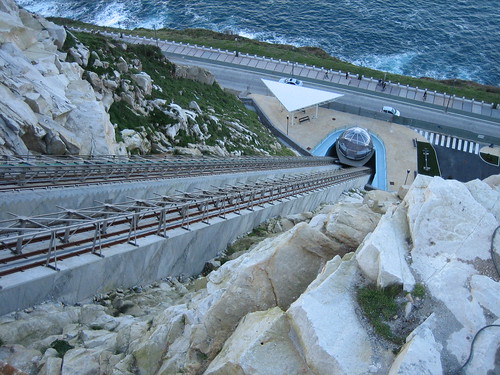
¿Está A Coruña preparada para una epidemia zombi?

Mucho me temo que no. El principal problema es el cuello de botella a la salida, que haría muy difícil la evacuación:

El tema no fue mencionado por ninguno de los partidos durante las recientes elecciones municipales. Una triste muestra de la indiferencia de los políticos por las verdaderas preocupaciones de los ciudadanos.

Quizás las mejor estrategia en caso de epidemia zombi sería atrincherarse en la Torre de Hércules. O mejor aún: en el depauperado Centro de Ocio del puerto (que ya tiene un aire post-apocalíptico, todo sea dicho). Víveres no faltarían, porque la mayor parte de los locales son de comidas. El problema es que, al contrario que en los centros comerciales estadounidenses (al menos los que salen en las películas), no existiría una tienda de armas de fuego que poder saquear para defenderse de las hordas zombi. Pero quizás la tienda de comics y demás frikadas tenga una katana de pega (posiblemente de Naruto). La gran cantidad de locales vacíos haría sencillo alojar a los supervivientes.

Alternativamente, podría montarse uno en la Arielita y confiar en que, como suele pasar, quede averiada a medio camino, felizmente inaccesible.

Si algún coruñés previsor ha concebido un plan mejor, estaría interesado en escucharlo.

Edit: Una ventaja del apocalipsis zombi sería que la eterna polémica A Coruña/La Coruña quedaría obsoleta al pasar la ciudad a denominarse "Zona de Infestación X-7013".

Monday, July 23, 2007

It kinda looks like NY

Bologna in the Middle Ages.

Another city rife with with towers is Sharn. It has the disadvantage of being imaginary. (Is Bologna real? I haven't been there so I can't tell.)

Sunday, July 22, 2007

Evangelistic Atheism

For a long time I have thought that modern evangelistic atheism (Dawkins, Hitchens, Dennet, et al.) is very close to the mindset of the early christians. Let's remember that those early christians were considered "atheists" by the pagans, and that they showed a pronounced skeptical streak. See the post The Original Atheists at Crooked Timber, and also the comments.

Going a little further back, Elijah's questioning of Baal's priests is almost scientific. He repeatedly asks for proof of their claims, derides them when that proof is not forthcoming, and then provides proof for the power of his own god. Some christians resent the snarkiness of the evangelistic atheists, but that snarkiness is nothing compared to that of Elijah (even without the ensuing massacre). Also, many of the arguments against idolatry in the Bible are pretty cogent and subscribable by modern atheists, who only carry them a little further. For the atheists, only Reason should be worshipped.

The book Black Mass by philosopher John Gray seems to make similar points, at least judging from the reviews.

Saturday, July 21, 2007

The Ethical Treatment of Books

Books are kept not on open shelves but in locked chests. Students who borrow are cautioned not to scratch grooves in the margin with their fingernails or to use straws from the lecture floor as placemarks. A Jewish ethical treatise warns that a man must not express his anger by pounding on a book or by hitting people with it. The angry teacher must not hit the bad student with a book, nor should the student use a book to ward off blows.

(Joseph and Frances Gies: Life in a Medieval City)

Friday, July 20, 2007

Used books from overseas

When buying used books from online bookstores, overseas shipping rates tend to end up surpassing the cost of the books themselves, frequently disuading me from the purchase.

BetterWorld.com delivers books to anywhere in the world for a mere $2.97, which is nice if you don't mind waiting a bit for your order (I don't). Some good deals there. They also sell through AbeBooks.

An excellent online bookstore for non-used books is The Book Depository. Free delivery, and the books tend to be cheaper than their Amazon equivalents once shipping is included.

Thursday, July 19, 2007

Hell is the absence of Blog

I post again, and sooner than forever!

Actually, the absence of Blog is not really Hell. It's more like a slight, liminal itch that you scratch by typing.

Saturday, June 23, 2007

Posting stops here

For a long time. Maybe forever.

Friday, June 22, 2007

Why...

..."filmed theatre" is a derogatory expression when applied to cinema, while "graphic novel" is supposed to dignify comic books?

Wednesday, June 20, 2007

Robert Aickman

“I found that I was thinking many deep thoughts. And then I noticed that a small tear was slowly falling down the Contessa's face. Without thinking, I sprang up; but then the Contessa smiled, and I sat down. One of my deep thoughts was that it is not so much particular disasters that make people cry, but something always there in life itself, something that a light falls on when we are trying to enjoy ourselves in the company of others.”

(Robert Aickman: Pages from a Young Girl's Journal)

Tuesday, June 19, 2007

Antinatural Aesthetics

The tribal disdain for nature extended into its active denigration of hair, agriculture, childbirth and even, perhaps, representational art.

In all of this the tribe was proclaiming that while its dominance derived from nature and was beyond question, its superiority meant that nature had no further claim on it. Everything else was created by the tribe itself, particularly the ornate and elaborate tattoos and paintings on members’ bodies.

(Edward Rothstein: Postmodern Thoughts, Illuminated by the Practices of a Premodern Tribe)

Silence was absolute, save for the purl of water under the hull. At night a pair of large moons cast a serene light through the foliage in a manner which Maihac found almost dreamlike in its effect. He said as much to Bariano, who responded with a condescending shrug. "I am surprised to find you so enthusiastic. It is, after all, a mere trick of nature." [...] "It is simply that your aesthetic judgments are amorphous. It is naive to detect beauty where none has been specifically intended. The subject is large. Often you will notice an agreeable aspect of nature, effected by random or mathematical processes. It may be serene and congenial, but it is the work of chance and lacks the human afflatus. There is no pulse of positive creativity to infuse it with true beauty."

(Jack Vance: Night Lamp)

Monday, June 18, 2007

Watch empires fall

I have been searching for software that provides the kind of information historical atlases do, but in animated form. The idea is to watch empires fall and frontiers fluctuate as years go by. Something like this flash animation of Middle East history, but more detailed and with some degree of user control over how the information is displayed.

I have found a commercial program called Centennia, which does just that:

CENTENNIA is a map-based guide to the history of Europe and the Middle East from the beginning of the 11th century to the present. It is a dynamic, animated historical atlas including over 9,000 border changes. The map controls evolve the map forward or backward in time bringing the static map to life. Our maps display every major war and territorial conflict displaying the status of each region at intervals of a tenth of a year. The maps reflect actual "power on the ground" rather than internationally-sanctioned or "recognized" borders.

You can download it and try it for free, although the trial version is circumscribed in time to the years between 1789 and 1819.

Then there's AtlasOfWorldHistory.com, which I haven't tried yet. Also, games like Europa Universalis may offer similar functionality, although it would be constrained to the level of detail of the gamemap.

Anyone knows of more programs like these?

Edit: I found another one, from the BBC.

Sunday, June 17, 2007

¿Qué es poesía? (2)

"¿Qué es poética? El arte de hacer coplas. ¿Qué son coplas? Unos montoncitos de líneas desiguales, llamadas versos. ¿Qué es un verso? Un número determinado de sílabas. ¿Qué dificultad ofrece su composición? Los consonantes. ¿Cómo se adquieren estos consonantes? Comprando un Rengifo por tres pesetas. ¿Qué otra cosa es necesaria además de esto para hacer cualquiera obra poética digna de la luz pública? Un poco de práctica, y otro poco de poca vergüenza."

(Leandro Fernández de Moratín: La derrota de los pedantes)

808.1 D543. Diaz Rengife, Juan. Arte poetica espanola, con una fertilissima silva de consonantes comunes, prepios, esdruxulos y reflexos, y una divino estimulo del amor de Dios. Madrid, 1644.

(de aquí)

Saturday, June 16, 2007

The Penis is Evil

"The penis is evil. The penis shoots seeds, and makes new life, and poisons the earth with a plague of men, as once it was. But the gun shoots death, and purifies the earth of the filth of brutals. Go forth and kill!" Why oh why there can't be more science fiction movies like Zardoz?

I think Borges would agree with Zardoz, about penises if not about guns. "Mirrors and copulation are abominable." Come to think of it, wasn't a long mirror scene of some kind in Zardoz?

Wikipedia has a list of fictional depictions of immortality, including Zardoz and Borges' The Immortal. But, no Jack Vance's To Live Forever!

A remake of Zardoz could tap into modern blue state / red state anxieties in the US. The problem is, where to find an actor as hairy as Connery? Because Zed must be hairy, to make him stand out from the effete, metrosexual immortals. And yet, I don't think Robin Williams would be good for the part.

Friday, June 15, 2007

El Lobo y el Cordero

Traduzco un pasaje de Gene Wolfe sobre Jesucristo. La cita original se puede encontrar en este artículo sobre Wolfe en First Things (recomiendo leer el original, porque mis habilidades de traductor no son para tirar cohetes.)
Ha sido dicho miles de veces que Cristo murió bajo tortura. Muchos the nosotros hemos leído tantas veces que él fue "un humilde carpintero" que sentimos un atisbo de náusea al ver esas palabras de nuevo. Pero nadie parece darse cuenta de que los instrumentos de tortura fueron madera, clavos, y martillo; que el hombre que construyó la Cruz fue indudablemente un carpintero también; que el hombre que clavó los clavos fue tanto un carpintero como un soldado, tanto un carpintero como un torturador. Muy pocos han percibido incluso que aunque Cristo fue un "humilde carpintero", el único objeto que se nos dice específicamente que contruyó no fue una mesa o una silla, sino un látigo.
Y ya que estamos hablado del aspecto más, digamos, "severo" de Jesús, aprovecho para enlazar al post Did Christ Ever Laugh? de Laudator Temporis Acti.
Wolfe es un católico con una teología un tanto particular. En una de sus entrevistas, menciona lo siguiente:

Uno de los lugares donde me diferencio de la doctrina Católica convencional es en que creo que los dioses del paganismo eran reales. No creo que fuesen merecedores de la adoración que recibían de los paganos. Creo que lo que muchos de los autores bíblicos están diciendo es: "Sí, esos son poderes verdaderos, pero es equivocado que les des los honores que son debidos solamente a Dios." Y creo que eso es exactamente correcto.

O sea, que Wolfe es un henoteísta, al menos en lo que respecta a los antiguos dioses olímpicos.

Todo lo anterior se refleja en su obra. El protagonista de El Libro del Sol Nuevo es una figura mesiánica, y un torturador de profesión (aunque esto último no se retrata de manera especialmente positiva). El Latro de Soldado de la Niebla es un mercenario romano utilizado como peón por los dioses griegos (su nombre es apropiado: "Latro" significa tanto "mercenario" como "peón" en latín). Y en El Libro del Sol Largo (del que sólo he leído el primer volumen), un sacerdote abandona progresivamente su culto politeísta para abrazar al dios "verdadero".

Wednesday, June 13, 2007

Did you know...

...that there is such a thing as metametaphysics? (Spotted at David Chalmer's blog, fragments of consciousness)

Then there's Conscious Entities, a blog about the mystery of consciousness. The entry titled Strange ideas (or, "Dead ends") is especially informative, and amusing.

The post Should Ethicists Behave Better? Should Epistemologists Think More Rationally? at The Splintered Mind is also very interesting.

Edit: Here is a review of David Benatar's Better Never to Have Been. And here is more commentary on the book.

Tuesday, June 12, 2007

The Limbo of Philistinism, the Hells of Nerdom

Oh boy. I hate those "1000 books/albums/movies you must read/listen to/watch before you die" tomes with the burning intensity of a thousand torrid suns. Not only they have the gall of insinuating my current status as a semi-cultured lummox, but very impolitely force me to confront my own mortality. Screw them.

As The Man Who is Thursday has mentioned, life is short and art is long. I mean, just estimate the number of weeks you expect to live. It's surprisingly small. You trudge your way across the canon in a race against time, lest the Grim Reaper makes you a visit and you are still halfway through War and Peace. How embarrassing that would be! At your deathbed, in presence of your mourning family, you must be able to declare proudly: "I have read every damned book in Harold Bloom's The Western Canon. I really did. A Voyage To Arcturus included." And then you die.

The calvinist fear of not being among the chosen is nothing compared to the cultured person's fear of not reading enough of the canon. And How to Talk About Books You Haven't Read cannot help you because, deep inside, you would still feel guilty about cheating. (War and Peace was about Russia, btw.)

Literalizing things a little too much, one could imagine a phildickian religion whose soteriology required plowing through a humongous reading list of great literature, as the only way to achieve salvation. Its adherents would picture the Judgement of Souls as a cocktail party with Radamanthus, in which they must appear knowledgeable and respond smartly to Raddy's cultured conversation.

There could be heresies, and even religious wars about the precise composition of the Canon, because an incorrectly selected one will damn you to the Limbo of Philistinism or, even worse, the Hells of Nerdom. (Does The Left Hand of Darkness really belong in Bloom's selection? Why not a more muscular planetary romance?)

Edit: this exists.

Saturday, June 09, 2007

Mirror, mirror

(NOTE: This is an old post from February 23, 2007 that mysteriously dissapeared when I upgraded to the new version of Blogger. Exhumed from the Google cache.)

This post on Centauri Dreams describes an extremely interesting propulsion technology called "Photonic Laser Thrusters". It works by bouncing photons betweeen two confronted mirrors thousands of times, so that the mirrors are pulled apart by radiation pressure.

It reminded me of a rather more fanciful method of transport involving confronted mirrors, imagined by Gene Wolfe in The Shadow of the Torturer:

Father Inire drew the wall of the octagon closed behind them. It was a mirror in which she could see his face and his arm and shining infinite robes reflected. Her own form too [...] but there seemed to be another girl -her own face peering over her shoulder; then another and another and another, each with a smaller face behind it. And so on ad infinitum, an endless chain of fainter Domnina-faces.

She realized when she saw them that the hall of the octogonal enclosure through which she had pased faced another mirror. The light of the blue-light lamp was caught by them all and reflected from one to another as boys might pass silver balls, interlacing and intertwining in an interminable dance.

A bit of technobabble follows, explaining how the mirrors work as a teletransporter (there's also a homage to Borges). Quite enchanting, really; though I hope the theory behind the "Photonic Laser Thrusters" is a bit more solid...

Alexander Bogdanov

In 1924, Bogdanov started his blood transfusion experiments, apparently hoping to achieve eternal youth or at least partial rejuvenation. Lenin's sister Maria Ulianova was among many who volunteered to take part in Bogdanov's experiments. After undergoing 11 transfusions, he remarked with satisfaction on the improvement of his eyesight, suspension of balding, and other positive symptoms. The fellow revolutionary Leonid Krasin wrote to his wife that "Bogdanov seems to have become 7, no, 10 years younger after the operation".

In 1925-1926, Bogdanov founded Institute for Haemotology and Blood Transfusions, which was later named after him. After Lenin's death, he was commissioned to study Lenin's brain and, if possible, to resuscitate his body. In his letters to the Soviet leaders Joseph Stalin and Bukharin he dreamed of physically rejuvenating the Bolshevik party leadership.

(Wikipedia entry for Alexander Bogdanov)

The totalitarian ruler who seeks to extend his lifespan through artificial means is a staple of the science fiction genre. The most notable example would be Robert Silverberg's Shadrach in the Furnace, but there's also Scott Westerfeld's The Risen Empire, the Emperor from Warhammer 40K, and so on.

Imagine Bogdanov's loony experiments actually worked, conferring immortality or a greatly extended lifespan to the members of the soviet nomenklatura. There you have a really intriguing premise for an alternate history novel. A world where the term "gerontocracy" would take an altogether creepier meaning... You could even throw in some allusions to Koshei the Deathless for good measure.

Bogdanov's Red Star appears in China Mieville's list of Fifty Fantasy & Science Fiction Works That Socialists Should Read. It also was one of the inspirations for Kim Stanley Robinson's Red Mars (a book which, I confess, I didn't manage to finish).

Friday, June 08, 2007

Literature of Travel and Exploration, an Encyclopedia

Here is the site for Routledge's Literature of Travel and Exploration, an Encyclopedia. If features all the entries, without the accompanying text of course. However, the suggestions for further reading are included, which is very helpful.

Looking for some of those entries in Wikipedia, I found interesting things like the page for Benjamin of Tudela. His "Itinerary" is now on my to-read list.

Wednesday, June 06, 2007

El Libro de Oro

Al parecer, la Fundación Paul Allen posee un cierto número de Ediciones Integrales de Vance, que está dispuesta a donar sin coste alguno para los recipientes. Detalles aquí.

Creo que la Biblioteca Nacional de Argentina debería solicitar esa donación. El por qué es evidente...

En un capítulo de La Sombra del Torturador de Gene Wolfe, se narra el encuentro del protagonista con un bibliotecario ciego y anciano llamado Ultan, responsable de la biblioteca real en la ciudad de Nessus. El bibliotecario le habla de un método para reclutar aprendices propio del gremio: El Libro de Oro. Es éste un volumen tan absolutamente fascinante que, cuando se lo presentan a un niño, queda totalmente embelesado por él, y a partir de entonces orienta su vida al servicio de los libros.

Ultan es claramente Jorge Luis Borges; la inmensa biblioteca que supervisa se podría considerar un trasunto de Biblioteca Nacional Argentina en Buenos Aires, de la que Borges fue director durante 18 años. (Al parecer, Wolfe da indicios en su novela de que la ciudad de Nessus es una versión futura de Buenos Aires. Aunque a mí se me escaparon, la verdad.)

Ahora bien: Gene Wolfe ha mencionado en entrevistas que, para él, el Libro de Oro que leyó en su adolescencia fue... La Tierra Moribunda de Jack Vance. Por lo tanto, ¿qué mejor método de asegurar que el Libro de Oro se encuentre en la biblioteca de Ultan que solicitando la donación?

Obvio, ¿no?

Tuesday, June 05, 2007

To betray the future

The critical reception of Brave New World was largely chilly. Most reviewers were disgruntled or disgusted with what they saw as unjustified alarmism. H. G. Wells was downright offended. “A writer of the standing of Aldous Huxley has no right to betray the future as he did in that book,” Wells said.

(Caitrin Nicol, Brave New World at 75)

In the end [H. G. Wells'] contemporary political impact was limited. His efforts to help form the League of Nations became a disappointment as the organisation turned out to be a weak one unable to prevent World War II. The war itself increased the pessimistic side of his nature. In his last book Mind at the End of its Tether (1945) he considered the idea that humanity being replaced by another species might not be a bad idea. He also came to call the era "The age of frustration." He spent his final years venting this frustration at various targets which included a neighbour who erected a large sign to a servicemen's club.

(Wikipedia entry for H. G. Wells)

Mind at the End of its Tether looks like an interesting book.

More sunny philosophizing in this previous post.

Monday, June 04, 2007

¿Qué es poesía?

¿Qué es poesía?, dices mientras clavas en mi pupila tu pupila azul.

¡Qué es poesía! ¿Y tú me lo preguntas? Poesía... eres tú.

(Gustavo Adolfo Béquer)

¿Qué es poesía?, dices mientras clavas en mi pupila tu pupila atroz.

¡Qué es poesía! ¿Y tú me lo preguntas? Poesía... soy yo.

(José Agustín Goytisolo)

Gracias, amor

Gracias, amor
por tu imbécil comportamiento
me hiciste saber que no era verdad eso de
"poesía eres tú"
¡Poesía soy yo!

(Gloria Fuertes)

¿Qué es poesía?, dices mientras clavas en mi pupila tu pupila azul.

¡Qué es poesía! ¿Y tú me lo preguntas? Poesía... es lo que diga el Ministerio de Cultura.

(Chumy Chúmez)

Sunday, June 03, 2007

The Amazing Dostoevsky Machine

This is actually rather helpful. A site that allows you to replace those unpronunceable, indistinguishable, unrememberable russian names in Crime and Punishment with more reader-friendly ones.

In fact, there should be more of those amazing machines, with extended capabilities not limited to name substitution. In epics, for example, references to dusty old gods nobody cares about could be replaced by appereances of modern comic-book heroes. Superman is Apollo (he receives his power fron the Sun, after all) and Batman could be Hades. Also, boring Bronze Age technology should be replaced by shiny spaceships and laserguns. As for now, those welcome changes must be implemented manually.

What? Disrespectful, you say? Bah. You are trying to sacralize one of the severe limitations of the printed word: its static, fixed nature. Do you really believe those ancient bards (blind or not) didn't adapt his yarns for each particular audience? Since in our mass society it would be impractical to have all those bards prancing around, we should prompt writers to create, instead of those monolithic strings of words they call "novels", algorithms that generate particularized texts based on each reader's set of cultural references and archetypes. Or, they could just stop writing and get into videogames.

Saturday, June 02, 2007

Muslim astronauts

How would a muslim astronaut orient himself towards Mecca?

I'm not being snarky here, I'm genuinely interested. And it's not as if there wasn't a great tradition of muslim travellers... why not extend it into the Space Age?

On a related note, what happens when a muslim finds himself in the exact antipodes of Mecca?

The problem of organizing prayer in strange new environments is not new:

During this march, Timur's army got far enough north to be in a region of very long summer days, causing complaints by his Muslim soldiers about keeping a long schedule of prayers in such northern regions.

(Wikipedia entry for Tamerlane)

Edit: I have searched Google for "muslim astronaut", and apparently the problem of space prayer has already been worked out:

Malaysian scientists and religious scholars are trying to determine how Muslims should behave in space, as the predominantly Islamic country prepares to dispatch its first astronaut next year.

More than 150 delegates attended a seminar to consider how to pray in space given the difficulties of locating Mecca and holding the prayer position in zero gravity; as well as other questions such as halal food and washing.

Monday, May 28, 2007

The banality of dawn

The sun shone, having no alternative, on the nothing new.

(Samuel Beckett: Murphy)

Gilford Gadberry had a contempt for dawns badly done. He knew how blatant and stylized the outdoor world can be in its pristine moments: the contrived shagginess of grass, the stupidity of trees, the falsity of flowers, the oafishness of the birds and their inept melody.

(R. A. Lafferty: Seven Story Dream)

Sunday, May 27, 2007

Fuego de San Telmo

E acabada la oración andando en la tormenta pareció una lumbre de candela en la gavia del mástil de la carraca, y otra lumbre en el madero que llaman bauprés, que está en el castil de vante, e otra lumbre como candela en una vara de espinelo que está en la popa, e estas lubres vieron cuantos estaban en la carraca, que fueron llamados que las viniessen a ver, e duraron una pieça desí dessaparecieron e no cessava en todo esto la tormenta

(Ruy González de Clavijo: Embajada a Tamorlán)

El fuego de San Telmo o Santelmo es un meteoro ígneo consistente en una descarga corona electroluminiscente provocada por la ionización del aire dentro del fuerte campo eléctrico que originan las tormentas eléctricas. Aunque se le llama «fuego», es en realidad un plasma de baja densidad y relativamente baja temperatura provocado por una enorme diferencia de potencial eléctrico atmosférica que sobrepasa el valor de ruptura dieléctrica del aire, en torno a 3 MV/m

Este fenómeno toma su nombre de San Telmo, patrón de los marineros, quienes habían observado el fenómeno desde la antigüedad y creían que su aparición era propicia.

(Fuego de San Telmo en Wikipedia)

E estas lumbres que así vieron dezían que era fray Pero Gonçález de Tuy, que se avían encomendado a él, e otro día amanecieron cerca destas dichas islas e a ojo de la isla de Sicilia con buen tiempo seguro.

(Ruy González de Clavijo: Embajada a Tamorlán)

Pedro González Telmo (Frómista, Palencia, ca. 1180/1190 – Santiago de Compostela, 15 de abril de 1246) fue un sacerdote católico español [...] Es patrono de la ciudad de Tuy y de la diócesis de Tuy-Vigo, donde se celebra su fiesta el lunes de la segunda semana de pascua.

(Pedro González Telmo en Wikipedia)

En la advocación popular se lo confundió con San Erasmo o Elmo, también venerado por los navegantes, y recibió por ello el nombre de Telmo. En la iconografía se lo representa vestido con el hábito negro de la orden dominica, llevando en la mano un cirio azul que representa al fuego de San Telmo, o directamente una llama azul; a veces se lo representa alimentando a los pescadores.

(íbid.)

Saturday, May 26, 2007

A guy who speaks chinese

Searle's response to the Systems Reply is simple: in principle, the man can internalize the entire system, memorizing all the instructions, doing all the calculations in his head. He could then leave the room and wander outdoors, perhaps even conversing in Chinese. But he still would have no way to attach "any meaning to the formal symbols". The man would now be the entire system, yet he still would not understand Chinese. For example, he would not know the meaning of the Chinese word for hamburger.

(The Chinese Room Argument on the Stanford Encyclopedia of Philosophy)

Platform virtualization is performed on a given hardware platform by "host" software (a control program), which creates a simulated computer environment (a virtual machine) for its "guest" software. The "guest" software, which is often itself a complete operating system, runs just as if it were installed on a stand-alone hardware platform. [...] For the "guest" system to function, the simulation must be robust enough to support all the guest system's external interfaces, which (depending on the type of virtualization) may include hardware drivers.

(Wikipedia entry for Virtualization)

The "external interfaces" for the guy who speaks chinese would be his sensory organs (input) and his mouth and extremities (output). It would be nice if there were upgradeable drivers for our central nervous system; I'm a clumsy person with poor reflexes.

Cole (1991) offers an additional argument that the mind doing the understanding is neither the mind of the room operator nor the system consisting of the operator and the program: running a suitably structured computer program might produce answers submitted in Chinese and also answers to questions submitted in Korean. Yet the Chinese answers might apparently display completely different knowledge and memories, beliefs and desires than the answers to the Korean questions — along with a denial that the Chinese answerer knows any Korean, and vice versa. Thus the evidence would be that there were two non-identical minds (one understanding Chinese only, and one understanding Korean only).

(The Chinese Room Argument on the Stanford Encyclopedia of Philosophy)

Typically, many such virtual machines are simulated on a given physical machine.

(Wikipedia entry for Virtualization)

Multiple Operating Systems running in a single machine as a (useful!) form of Dissociative Identity Disorder.

Friday, May 25, 2007

Choose your name

They all had tough names except Ceran. Manbreaker Crag, Heave Huckle, Blast Berg, George Blood, Move Manion (when Move says "Move," you move), Trouble Trent. They were supposed to be tough, and they had taken tough names at the naming. Only Ceran kept his own—to the disgust of his commander, Manbreaker.

"Nobody can be a hero with a name like Ceran Swicegood!" Manbreaker would thunder. "Why don't you take Storm Shannon? That's good. Or Gutboy Barrelhouse or Slash Slagle or Nevel Knife? You barely glanced at the suggested list."

(R. A. Lafferty: Nine Hundred Grandmothers)

Mur took the paper into the cottage, and puzzled out the sense of the characters, with occasional help from Eathre. His face grew longer and longer as he read: "Bougozonie, the Seven-Spasm Ecclesiarch. Narth Homank, who ate but one nut and one berry each day. Higajou, who reorganized Pure Boy training. Faman Cocile, who allowed himself to be gelded by Shimrod Forest bandits rather than alter his creed of non-violence and peace. Borgad Polveitch who denounced the Ambisexual Heresy..." At last Mur put aside the paper.

"What is your selection?" asked Eathre.

"I can't make up my mind."

(Jack Vance: The Anome)

Sunday, May 20, 2007

Neuromancer movie in the works

Looks like William Gibson's Neuromancer is finally coming to the big screen. It's going to be directed by Joseph Kahn, the guy who did Torque (check out this expressive review of the movie on CHUD).

As I have noted before, Neuromancer is so utterly Eighties that the only way it could work is as a retrofuturistic nostalgia piece. Nothing wrong with that; in fact I would absolutely love to see the movie done that way.

Gibson's Matrix was a powerful metaphor for the information age, but in a world full of World of Warcraft addicts, perhaps the idea, although prophetic and visionary in its time, isn't as new and exciting as it once was. Only unrealized visions are able to maintain their lustre.

The abstract, neon-lit empyrean envisioned by Gibson was an escape from the flesh. MMORPG users want to escape from their own flesh, too, but into the idealized body forms provided by their avatars. I guess Cronenberg was more prescient in that aspect.

Don't forget to check Paul Brians' study guide for the novel.

Saturday, May 19, 2007

What is best in life?

Some of the Mongol tribes were literate, so we have written collections of the history and traditions of the Mongols, as well as accounts by Persian and Chinese chroniclers. One of the most telling is Genghis Khan's purported value statement. During a respite from his campaigns, he once asked some friends what the greatest pleasure was. After they variously answered hunting, falconry, or archery, Genghis is reputed to have said:

"The greatest joy a man can know is to conquer his enemies and drive them before him. To ride their horses and take away their possessions. To see the faces of those who were dear to them bedewed with tears, and to clasp their wives and daughters in his arms"

Or to paraphrase it in the bluntest possible modern terms: "To kill people, take their property, see and enjoy the pain you have caused their families, and rape their women as a final gesture of power."

From here. (And from here, too...)

At a party with fellow Bolsheviks in their Siberian exile shortly before the revolution, everyone present was asked to name their favourite pleasures. Several mentioned the seduction of women, others chose more politically correct activities in the service of the proletariat. Stalin, who had just seduced and impregnated a 13-year-old girl in the village, chose what was for him a more intense satisfaction: "My greatest pleasure is to choose one's victim, prepare one's plans minutely, slake an implacable vengeance, and then go to bed. There's nothing sweeter in the world." His comrades did not take him seriously, which was to be their misfortune, to say nothing of the whole country's.

From here.

Wednesday, May 16, 2007

Empires of the land, the sea, and the air

Fuelled by grass, the Mongol empire could be described as solar-powered; it was an empire of the land. Later empires, such as the British, moved by ship and were wind-powered, empires of the sea. The American empire, if it is an empire, runs on oil and is an empire of the air. On the world’s largest landmass, Iraq is a main crossroads; most aspirants to empire eventually pass through there.

(from this New Yorker article by Ian Frazier)

I'm currently reading a spanish translation of The Travels of Ibn Battuta. Battuta was a muslim traveller form the fourteenth century, roughly a contemporary of Marco Polo. The book paints a pretty depressing and desolate picture of Baghdad, reduced by the mongol invasion to a shadow of its former glory under the abbasids.

Here is a nice collection of links to material about Ibn Battuta on the web. And here is the Wikipedia entry for the Battle of Baghdad (1258).

John Dolan wrote an interesting piece on the Mongols, avaliable here.

I have a copy of The Empire of the Steppes I found really cheap on Abebooks, but I still haven't got around to reading it. This other book also looks very interesting.

Let's finish by quoting this post from The Toynbee Convector:

But now we come to the great revolution: a technological revolution by which the West made its fortune, got the better of all the other living civilizations, and forcibly united them into a single society of literally world-wide range. The revolutionary Western invention was the substitution of the Ocean for the Steppe as the principal medium of world-communication. This use of the Ocean, first by sailing ships and then by steamships, enabled the West to unify the whole inhabited and habitable world [...] The steppe-ports were put out of action when the ocean-going sailing-ship superseded the camel and the horse; and now that, under our eyes, the ocean-going steamship is being superseded by the aeroplane we may ask ourselves whether the centre of the world is not likely to jump again – and this time as sensationally as in the sixteenth century – under the impetus of a technological revolution that is at least as radical as the sixteenth-century substitution of da Gama’s caravel for Babur’s tipuchaq.

Saturday, May 12, 2007

Jack Vance interview on YouTube

Vance was interviewed in November 12th, 1976 for the radio program "Hour 25".

I have uploaded the interview to YouTube. Here is a link to the first part (out of twelve).

Friday, May 11, 2007

Today I heard two people...

...talking about web services on the street.

True story.

I also heard one elderly person telling another (in Spanish): "You don't know how time flies... Yes, time does fly."

True story.

Wednesday, May 09, 2007

La insuficiencia del psicoanálisis

A mi juicio, uno de los fracasos de la teoría freudiana es no haber atribuido suficiente importancia en el desarollo de la personalidad masculina a la humillación infantil de quedar el último cuando se eligen los equipos de fútbol en el patio del colegio. Experiencia traumática e inconfesable que sospecho está en la raíz de innumerables neurosis. Vamos, que el Complejo de Edipo es una nimiedad a su lado. (Todavía no he decidido qué nombre daré a mi neurosis balompédica.)

Quizás, estimado lector, consideres que las idea que acabo de exponer es absurda. Algo comprensible, ya que posiblemente tú mismo hayas sufrido la experiencia sin haber conseguido asimilarla, lo que se manifiesta como una reticencia inconsciente e irracional a aceptar mi teoría. Como ves, tu misma crítica termina reforzándola.

Monday, May 07, 2007

Yesterday's Futures

Paleo-future is an interesting blog about past conceptions of the future.

Tales of Future Past is a site with a similar theme, also very interesting.

Here is the Wikipedia entry for Retrofuturism.

Terminal City is an enjoyable retrofuturistic comic.

And here is the inevitable link to William Gibson's short story The Gernsback Continuum.

Thursday, May 03, 2007

Casting lots for divination

In Jack Vance's novel The Chasch, part of his Planet of Adventure series, the magicians of the emblem tribe practice divination by casting lots:

The Chief Magician departed, to return with a box carved from a single huge bone. He turned to Jad Piluna. "To which moon do you call for justice?" [..] The Chief Magician reached into the box, brought forth a disk, on one side pink, on the other blue. "Stand clear, all!" He spun the disk into the air. It tilted, wobbled, seemed to float and glide, and landed with the pink side on top. "Az, moon of virtue, has decided innocence!" called the magician. "Braz has seen no cause to act."

This is a good example of how Vance's imagined societies aren't as implausible as they seem at first sight. The casting of lots for divination occurs in a few places of the Hebrew Bible; in fact the Urim and Thummim may have served for that purpose.

Another reality-inspired (and not at all exotic, judging from current events) bit in Vance's work is the custom of awaile, depicted in The Wannek.

In this post of his blog, John Crowley calls for sf/fantasy authors to imagine societies at least as strange as actually existing ones:

One of my contentions about fantasy novels, and science-fantasy and future-world novels too, is that the society of the distant future, or an alien species, or another planet, or an alternate universe, ought to be at least as complex and unlikely-seeming (to Western European/American-culture-based writers in English) as the societies, mentalities and cultures that humans have in fact produced.

This advice is all to often ignored. Although Vance, as we have seen, can't be accused of doing so.

Wednesday, May 02, 2007

The Milleriad

Here is a less than ethusiastic evaluation of the work of Frank Miller (link spotted at John C. Wright's blog).

Here is a non-appreciative review of 300 by the War Nerd (which agrees with the first essay on Victor Davis Hanson's current state of whoredom).

Finally, here is Lucius Shepard's review of the movie Sin City (registration required; use BugMeNot).

Tuesday, May 01, 2007

28 pitufisemanas después

Ya casi no me acordaba de este estremecedor episodio de Los Pitufos... empieza normalmente, pero a partir de 2:15 se transforma en una versión pitufa de 28 Semanas Después y su predecesora 28 Días Después. Los pitufos infectados exiben todas las características de los "zombies rápidos" imaginados por Danny Boyle: extrema agresividad, un aumento de su fuerza física... cierto que les falta vomitar pitufisangre, pero quizás fue censurado para emisión. Tendremos que esperar a la edición especial en DVD con el director's cut.

Los Pitufos: una serie adelantada a su tiempo. Ahora supongo que debería comenzar con las típicas bromas sobre Pitufina, y el carácter totalitario de la sociedad pitufa. Pero te las ahorraré, estimado lector. Tienes cosas más importantes que hacer con tu tiempo. (Ojalá la un tanto sobrevalorada Donnie Darko hubiese tenido la misma delicadeza.)

Sunday, April 29, 2007

Quimioterapia y Gas Mostaza

Hojeando el libro El cáncer se cura, del doctor José Ramón Germà Lluch (editorial Planeta) me encontré con un dato que desconocía: el primer tratamiento de quimioterapia fue básicamente una versión intravenosa del gas mostaza empleado en las trincheras de la Primera Guerra Mundial.

Al parecer, durante la Segunda Guerra Mundial, un grupo de personas fue expuesto accidentalmente a la substancia. Los consiguientes análisis (y autopsias) revelaron que el gas mostaza atacaba sobre todo a las células que crecen más rápidamente, lo que llevó a algunos médicos a conjeturar que podría ser empleado para combatir el cáncer.

Friday, April 27, 2007

2001 and Intelligent Design

I don't understand why proponents of Intelligent Design haven't culturally appropriated 2001: A Space Odyssey for their own ends. Because Kubrick's movie (and even more Clarke's novel) can be understood as the most effective artistic representation of their ideas. Mankind evolving not exclusively by natural means, but receiving periodic visitations from a brick that prompts it to advance to the next level and so on.

Of course, Clarke wouldn't appreciate that interpretation, but that's irrelevant. The book speaks for itself. In fact, science fiction as a whole seems fascinated by Intelligent Design. There are more mysterious "progenitor" races than you can shake a stick at. It's almost as if the plain vanilla conception of darwinian evolution was boring, and you need to have your ADN trampled by some exotic alien race or transcendent being to be considered cool.

Would a strictly Darwin-compliant version of the movie still seem as "deep" and "profound"? We could try. I want my monolith-free cut of 2001, now!

Wednesday, April 25, 2007

The Children of Hurin Linkorama

Here is an interesting interpretation of The Children of Hurin by an eccentric commentator. Here is a less interesting review from The Washington Post.

And here is the best review ever penned of Peter Jackson's version of Lord of the Rings.

Monday, April 23, 2007

Aural perils of chick flicks

I accompanied my girldfiend to see the movie Music and Lyrics, in an act of retinal immolation for the sake of love. And now, no matter how much I try, I CAN'T GET THIS DAMN SONG OUT OF MY HEAD!!! (Warning: do not go through that link unless you want a good portion of your mental throughput co-opted by that campy yet insidious musical concoction.)

It's driving me crazy. Maybe I should fight fire with fire...
Eight, sir; seven, sir;
Six, sir; five, sir;
Four, sir; three, sir;
Two, sir; one!
Tenser, said the Tensor.
Tension, apprehension,
And dissension have begun.
See here.

Sunday, April 22, 2007

Dwarf Fortress and the Great War

Dwarf Fortress seems to be a very interesting roguelike game about... dwarfs building a fortress. I can see how planning and slowly expanding your settlement while fending off external threats must be hugely compelling.

I would like to play a variation of this game, in which you don't build fortresses, but WWI-like trenches. In a way, it would be very similar: trenches in the Great War started simple but grew to become extremely complex and expansive constructions over vast areas, warring fortresses separated by half of a kilometer at most, pitted one against the other in a mutual siege.

This base building oriented approach seems to me the only viable way to make a "realistic" game about trench warfare. I don't think a game from the perspective of an individual soldier would work, much more than a game in which you play a lamb going to the slaughter.

I can't wait to watch the Christmas truce reenacted by dwarfs symbolized by ampersands.

Saturday, April 21, 2007

Geography Time!

A neat -if extremely basic- flash game to test your knowledge of Geography. Is there a similar one, but with more things included, such as cities, geographic features, and the like?

Narrative Beings

The article I linked to in my last post is fairly interesting:

Once upon a time a philosopher wrote an article called ‘Don Quixote and The Narrative Self’. He commenced by saying: In this essay, I will discuss the question of whether our selves are constituted by narratives, ie stories. Are we like Don Quixote, whose self was created by his reading of medieval romances: are we Homo quixotienses, the narrative self? Or are we rather like the protagonist of Sartre’s novel Nausea, Antonin Roquentin, whose life did not form any narrative unity? Are we in other words rather Homo roquentinenses?

Our identities, created by narratives? That reminds me of a passage from the preface of R. A. Lafferty's The Devil is Dead:

We will not lie to you. This is a do-it-yourself thriller or nightmare. Its present order is only the way it comes out of the box. Arrange it as you will.

Set off the devils and the monsters, the wonderful beauties and the foul murderers, the ships and the oceans of middle space, the corpses and the revenants, set them off in whatever apposition you wish. [...] Build with these colored blocks your own dramas of love and death and degradation. Learn the true topography: the monstruous and wonderful archetypes are not inside you, not in your own unconsciousness; you are inside them, trapped, and howling to get out.

By the way, some people think that Nabokov's Lolita has the best opening for a novel ever, but they're wrong. That honor corresponds to Lafferty's novel.

Friday, April 20, 2007

Travelogues

One of the reasons why I like travel literature is because it offers a delectable tension beteen its supposedly "it really happened!" quality and the unique opportunity for the author to invent a story about far away lands out of whole cloth, with no one in the vincity to contradict him. The classic example in fiction would be Odysseus spinning his tale for the Phaeacians. Giant monobrowed sheperds? Insatiable sex goddesses? Yeah Ody, suuure. Whenever I read a travelogue, ancient or modern, I'm constantly second-guessing the author. This could have happened... this was for self-aggrandizement... this was inserted or altered to resonate with an earlier event... In pure fiction, that tension doesn't quite exist.

For example, in Paul Theroux's excellent The Great Railway Bazaar, there are two running gags. One about people who don't manage to catch the train in time ("duffilled" writes the author) and another a tale told by various travellers about spending a night with a beautiful woman only to discover with the morning that "she" was really a man. There's a story-like progression in those running gags, however simple. At the beginning, a companion of Theroux is duffilled, near the end, he is duffilled himself. He is told the story about the transvestite a first time, and then a second, this second time with the twist that the narrator admits he didn't mind at all.

To what degree the original facts were bent to adopt such a story-like quality? Maybe they weren't bent at all, at least intentionally. Maybe it's just that we tend to remember not simply unrelated factoids, but sequences of events that make sense for us, that seem to go somewhere. Maybe it's not just a tendency, but an absolute requisite for our past experience to become intelligible. See this article.

Another neat thing about travelogues is that the author usually ends up telling us as much about himself -however indirectly- than as about the places he visits, despite the pretense to the contrary. And I like that pretense. In your face "this is going to be about ME ME ME" works, á la Rousseau's Confessions, feel a little too blunt.

Tuesday, April 17, 2007

Amok, Awaile

Running amok, sometimes referred to as simply amok (also spelled amuck or amuk), is derived from the Malay word mengamuk, meaning "to go mad with rage" (uncontrollable rage). In typical cases, a man who has shown no previous sign of anger and no inclination to resort to violence will take up a weapon in a sudden frenzy and attempt to kill everyone he meets. Amok episodes of this kind normally end with the amok-runner being killed by bystanders. The contrast between what was seen as the normal placid character of Malays and a sudden outburst of frenzied violence played to Western perceptions of the 'irrational' East.

(Wikipedia entry for Amok)

"What is this place?" he asked the driver, who gave him a glance of mild wonder.

"The Circle, site of Pathetic Communion, as you can see. You are a stranger in Settra?"

"Yes."

The driver consulted a yellow cardboard schedule. "The next event is Ivensday, when a nineteen-score comes to clarify his horrible desperation. Nineteen! The most since the twenty-two of Agate Crystal's Lord Wis."

"You mean he killed nineteen?"

"Of course; what else? Four were children, but still a feat these days when folk are wary of awaile. All Settra will come to the expiation. If you're still in town you could hardly do more for your own soul's profit."

(Jack Vance: The Wannek)

Dordolio gave an uneasy laugh. "There is a dark side to humanity, which is like a stone pressed into the mold. The upper side, exposed to sun and air, is clean; tilt it and look below, at the muck and scurrying insects...We of Yao know this well; nothing will put an end to awaile. But enough of such talk!"

(ibid.)

"It was awaile. The refuge from shame."

(ibid.)

A pair of links

The first is Explorion, a digital library full of historical travelogues in the public domain. I particularly recommend the narrative of Álvar Núñez Cabeza de Vaca.

And, once you have vicariously sated your wanderlust, go to the Hermitary to learn how to retreat from the world.

Come to think of it, are the hikikomori modern hermits? I would say yes. Pornographic anime watching hermits, but hermits nevertheless.

Thursday, April 12, 2007

Ports of Call reviewed at sfsignal

A review of Jack Vance's novel Ports of Call has been posted at sfsignal.

The best way to read the novel is in the Science Fiction Book Club volume that contains both Ports of Call and its continuation Lurulu. I found my copy dirt-cheap on Ebay.

Keeping track

Reading long novels in PDF format is a chore. You are tied to your computer and, furthermore, Adobe Reader doesn't allow you to create your own bookmarks. At most, it can reopen a document at the same place you left it the last time, but that's hardly a substitute. Go back a few pages to check something, and you'll need to find your way again. INCONVENIENT!

I had to resort to the crude meatspace practice of writing in a notebook the numbers of the pages at which I stopped reading. This is cumbersome, and besides cumbersome I feel it is inelegant, to track your progress across a complex tapestry of words with something as prosaic and brutally matter-of-fact as a string of numbers.

So now what I do is to copy some singular phrase and later use the search funcion to locate it. It's a bit more work, but if feels right. Plus, now when I finish a novel I get a little dadaist poem as a bonus. The last phrase in my notebook is currently "the slow growth and change of rite and dogma like his own rare thoughts, a chemistry of stars".

For physical books, the absolute best way to keep track would be to rip and burn each page once you have read it. It's the same for the book of your life: the past exist nowhere, and your memories are just the ashes of burnt days.

And, when dealing with the all-important genre of bathroom literature, already read pages can have other uses. Although that would create an odd link between speed reading and diarrhea.

Monday, April 09, 2007

Un error de traducción

El argumento de la novela de Walter M. Miller Cántico por Leibowitz gira en torno a un monasterio católico situado en unos EEUU que se recuperan lentamente de un apocalipsis nuclear. (Miller quedó traumatizado por su participación en el bombardeo del monasterio de Monte Cassino durante la 2ª Guerra Mundial; posiblemente sea ése el germen de la novela.)

En el comienzo del libro, un novicio está en el desierto realizando su ayuno cuaresmal, cuando se encuentra con un anciano judío que viaja a pie. El monje, que ha hecho voto de silencio, se ve en un aprieto ante las preguntas del anciano. Intenta comunicarse con él escribiendo:

El novicio cogió un pedazo de piedra caliza. Que el viajero supiese leer era estadísticamente improbable, pero decidió probar suerte. Ya que los dialectos vulgares empleados por el populacho no tenían ni alfabeto ni ortografía, escribió en latín: «Penitencia, Soledad y Silencio» sobre una gran piedra plana y las repitió debajo en inglés antiguo. Esperaba, a pesar de su no declarado deseo de tener alguien con quien hablar, que el viejo comprendería y le dejaría en su solitaria vigilia de cuaresma.

El peregrino sonrió burlonamente ante la inscripción. Su risa pareció una mueca fatalista más que otra cosa.

- ¡Vaya, escribiendo aún cosas periclitadas! -dijo, aunque sin condescender a admitir que había comprendido la inscripción.


La versión original en inglés de la última frase es:

"Hmmmm-hnnn! Still writing things backward," he said; but if he understood the inscription, he did not condescend to admit it.


El traductor se equivocó. La palabra "backward" se utiliza aquí no en el sentido de "pasado de moda, periclitado", sino en el sentido de "al revés". El anciano está haciendo referencia a que el Hebreo, al contrario que el Latín, se escribe de derecha a izquierda.

Friday, April 06, 2007

The Lives of Others

This movie was about the conflicts inherent in a monopoly on sexual satisfaction. The handsome dramatist with a magnetic personality manages to sport luscious, neumatic girlfriends in whatever sociopolitical system he finds himself in, while the awkward stasi agent and the porcine minister remain alone and sexually frustrated for the most part, having to resort to methods either pathetic or ignoble to receive their share of smoochies.

I think the movie was also about communism or something like that.

Down with Symbolism and Allegory!

Is there symbolism in Mirror?

No! The images themselves are like symbols, but unlike accepted symbols they cannot be deciphered. the image is like a clot of life, and even the author may not be able to work out what it means, let alone the audience. Pushkin's "My sadness is radian" is not a symbol but a an image. Tolstoy's dying Ivan Ilych feels as if he is confined inside a narrow intestine pipe, and cannot get out. What he feels is what the sick mans says. As long ago as the Middle Ages Japanese writers were decrying the interpretation of symbols in art. And quite rightly! The fewer symbols the better! Symbolism is a sign of decadence.

(Andrei Tarkovsky, in an interview)

I cordially dislike allegory in all its manifestations, and always have done since I grew old and wary enough to detect its presence.

(J.R.R. Tolkien)

Tuesday, April 03, 2007

Better never to have been

This book by Oxford University Press looks very interesting. From its Amazon editorial review:

David Benatar argues that coming into existence is always a serious harm. Although the good things in one's life make one's life go better than it otherwise would have gone, one could not have been deprived by their absence if one had not existed. Those who never exist cannot be deprived. However, by coming into existence one does suffer quite serious harms that could not have befallen one had one not come into existence. [...] The author then argues for the 'anti-natal' view -that it is always wrong to have children- and he shows that combining the anti-natal view with common pro-choice views about foetal moral status yield a 'pro-death' view about abortion (at the earlier stages of gestation). Anti-natalism also implies that it would be better if humanity became extinct. Although counter-intuitive for many, that implication is defended, not least by showing that it solves many conundrums of moral theory about population.

I suppose the conundrums referred to are things like the Repugnant Conclusion. From the entry in the Stanford Encyclopedia of Philosophy:

Christoph Fehige (1998) has suggested, in the tradition of Schopenhauer, that there are no lives with a positive well-being. In his account, only frustrated preferences count, and they count negatively, whereas satisfaction of preferences has no positive value. Since it is possible that a population with very high welfare only involves lives with complete preference satisfaction, the Repugnant Conclusion is avoided since any population with complete preference satisfaction is better than any population involving at least one frustrated preference. More troubling, however, is that this view implies a strong version of the Reversed Repugnant Conclusion: A population with very high positive welfare can be worse than an empty population. Since most lives with very high welfare can be assumed to have at least one frustrated preference, such lives are worse than non-existence according to Fehige's theory. Moreover, a theory about welfare that denies the possibility of lives worth living is quite counter-intuitive (Ryberg 1996a).

The user reviews are not uniformly positive: "A suicide note in book form", "Intergalactic cosmic spam", "You need a PhD to be this stupid". I suspect the adverse reactions come from fanaticised pro-existence zealots. However, members of the Voluntary Human Extinction Movement should love the book (I used to think the VHEMT was a joke, now I'm not so sure).

The short story Mutation Planet, by Barrington J. Bayley, features an alien race who collectively aspires to never to have been:

"And you," Eliot demanded, "What do you seek?"

"We," answered Zeed with an icy lack of hesitation, "seek NULLITY. Not merely to die [...] but to wipe out the past, never to have been." [...] "On my planet..." Zeed seemed to hesitate, "we regard it as an act of compassion to kill our offspring at birth. The unlucky ones are spared to answer nature's call to perpetuate the species. [...] We believe that ever since the first nervous system developed, the subconscious feeling has been present that it has all been a mistake."

A bit later, the same character declares:

"We all inhabit a vast dark," he repeated, "in which there is neither rhyme nor reason."

Sunday, April 01, 2007

300

Si vais a ver 300, dejaos el neocórtex a la entrada: para apreciar esta película basta y sobra el cerebro reptiliano.

La película me ha enseñado una serie de valiosas lecciones. Que matar al mensajero es una buena idea. Que retirarse del campo de batalla para poder luchar otro día es innoble (supongo que Miller prefiere los 300 a los 10000). Que la muerte en dicho campo de batalla es algo a lo que todo hombre que los tenga bien puestos debe aspirar (¡igualito igualito que los terroristas suicidas!). Que el mejor método para desenmascarar un traidor es darle matarile directamente.

Hay una casi constante voz en off que básicamente se limita a narrar lo que ya vemos en la pantalla con nuestros propios ojos. Posiblemente fue incluida a petición de la ONCE, a beneficio de los espectadores ciegos.

Aunque debo reconocer que la peli tiene algunas cosas que valen la pena. La imagen del árbol con los cuerpos ensartados (que recuerda al árbol del Alcaudón en Hyperion). Y la escena en el harén de Jerjes durante la cual Gollum es tentado por mutantes sexuales, deliciosamente decadente.

Lo que me pregunto es: ¿cuál será el próximo paso en la involución mental de Frank Miller? ¿Un vídeo en YouTube donde aparezca jugando con sus madelman, haciendo él mismo los ruiditos, explosiones, y pronunciamientos?

En cuanto a Zack Snyder, su mejor momento como director sigue siendo ese apocalipis suburbano a ritmo de Johnny Cash que es el comienzo de El amanecer de los muertos.

Cherries and kisses

I climbed up the tree, and threw down bunches of fruit, while they threw the stones back at me through the branches. Once Mademoiselle Galley, holding out her apron and throwing back her head, presented herself as a mark so prettily, and I took such accurate aim, that I threw a bunch right into her bosom. How we laughed! I said to myself, If my lips were only cherries, how readily would I throw them into the same place!

(Jean Jacques Rousseau: The Confessions, book four)

Friday, March 30, 2007

Jack Vance y un tal Ortega

Mensaje de lord Jaiko Jaikosa, presidente de la Cámara Ejecutiva de la Asamblea General del Valhalla, en Valhalla, Sistema Solar de la Estrella Tau de Los Gemelos, 8 de agosto de 1028:

«Os exhorto a no avalar tan siniestra medida. La humanidad ha tenido muchas veces tristes experiencias de lo que son las fuerzas de policía dotadas de excesivos poderes. Tan pronto como la policía deja de estar bajo la firme mano de una política responsable, se vuelve arbitraria, inmisericorde y construye una ley para su uso particular. Deja de pensar en la justicia para establecerse como una élite colmada de privilegios. Equivoca la actitud normal de precaución e incertidumbre de la población civil, y en vez del respeto comienza a utilizar sus armas de un lado a otro, con una euforia megalomaníaca. La gente deja de ser personas para convertirse en sirvientes. Una policía así se transforma simplemente en un conjunto de criminales uniformados, cuya característica más perniciosa es que resulta sancionada por la Ley. La mentalidad policíaca no puede considerar a un ser humano en otros términos que el de un objeto al que hay que procesar o expedientar. Nada significa la conveniencia pública ni la dignidad; las prerrogativas de la policía asumen el estado de una ley divina. Se pide la sumisión más completa. Si un agente de la policía mata a un civil, el hecho se considera una circunstancia lamentable; el agente actuó con un exceso de celo profesional. Si un civil mata a un policía, se conmueve el propio infierno. La policía echa espuma por la boca. Todos los demás asuntos quedan pospuestos hasta que el culpable de semejante y espantoso crimen es descubierto. Inevitablemente, al ser capturado es maltratado o incluso torturado por su intolerable presunción. La policía se queja de que no puede funcionar eficientemente, de que los criminales se le escapan. Es mejor siempre un centenar de criminales incontrolados que el despotismo de una fuerza de policía que actúa sin freno.»

(Jack Vance: El Rey Estelar)

Vance pone el discurso en boca de uno de sus personajes; su propia opinión quizás sea distinta. Aunque cabe mencionar que en el Oikumene de Los Príncipes Demonio, la policía (excepto a nivel local) es una organización privada sin estatus oficial especial o conexión directa con el gobierno. Un poco como el sistema que proponen algunos libertarios estadounidenses, o el que funcionó en Islandia entre los siglos X y XIII.

uno de los fenómenos más alarmantes de estos últimos treinta años [es] el aumento enorme en todos los países de las fuerzas de Policía. [...] es una inocencia de las gentes de "orden" pensar que estas "fuerzas de orden público", creadas para el orden, se van a contentar con imponer siempre el que aquéllas quieran. Lo inevitable es que acaben por definir y decidir ellas el orden que van a imponer — y que será, naturalmente, el que les convenga. [...] Cuando, hacia 1800, la nueva industria comienza a crear un tipo de hombre — el obrero industrial — más criminoso que los tradicionales, Francia se apresura a crear una numerosa Policía. Hacia 1810 surge en Inglaterra, por las mismas causas, un aumento de la criminalidad, y entonces caen los ingleses en la cuenta de que ellos no tienen Policía. Gobiernan los conservadores. ¿Qué harán? ¿Crearán una Policía? Nada de eso. Se prefiere aguantar, hasta donde se pueda, el crimen. "La gente se resigna a hacer su lugar al desorden, considerándolo como rescate de la libertad." "En París — escribe John William Ward — tienen una Policía admirable; pero pagan caras sus ventajas. Prefiero ver que cada tres o cuatro años se degüella a media docena de hombres en Ratcliffe Road, que estar sometido a visitas domiciliarias, al espionaje y a todas las maquinaciones de Fouché". Son dos ideas distintas del Estado. El inglés quiere que el Estado tenga límites.

(José Ortega y Gasset: La rebelión de las masas)

No sé no sé... me pregunto si la gente que vive en barrios conflictivos podría permitirse el lujo de mantener opiniones semejantes.

En esta página se puede encontrar información sobre la evolución de la policía en el área de Londres entre los siglos XVII y XIX.

Ah, y ya que estoy en plan de comparar a Vance con autores españoles, aprovecho para recordar este post.

Wednesday, March 28, 2007

Our Friends The Cows

Cows are amongst the gentlest of breathing creatures; none show more passionate tenderness to their young when deprived of them; and, in short, I am not ashamed to profess a deep love for these quiet creatures.

(Thomas de Quincey: Confessions of an English Opium-Eater)

I, too, love cows. Not enough to stop eating them, though.

I wonder how many of us flesh devourers would turn vegetarian if we had to slaughter the animals ourselves, instead of finding their meat neatly and innocently packaged at the supermarket, with nary a hint of the corresponding bovine assasination. I guess I could kill a pig: they are ugly and nasty, and would no doubt eat me if they had the chance. But a cow? That sweet, good natured animal?

Hunt your own food, coward, division of labor be damned! Take your spear and pursue the mammoth! Otherwise, wait until In vitro meat becomes a practical reality.

What I feared most, but perhaps only through ignorance of zoology, was, lest, whilst my sleeping face was upturned to the stars, some one of the Brahminical-looking cows on the Cambrian hills, one or other, might poach her foot into the center of my face. I do not suppose any fixed hostility of that nature to English faces in Welsh cows: but everywhere I observe in the feminine mind something of beautiful caprice, a floral exuberance of that charming wilfulnes which characterises our dear human sisters I fear through all worlds.

(Thomas de Quincey: Confessions of an English Opium-Eater)

Monday, March 26, 2007

Saturday, March 24, 2007

Mormon transhumanism

It exists.

Actually, not as absurd or incongruous as it seems at first sight. According to my (admitedly very limited) knowledge of Mormonism, some tenets of the religion resonate with transhumanist principles an awful lot. I'm thinking of the physical nature of God, the belief in continual eternal progression, the possibility of, in time, becoming a god yourself, and so on.

God himself was once as we are now, and is an exalted man, and sits enthroned in yonder heavens! That is the great secret. If the veil were rent today, and the great God who holds this world in its orbit, and who upholds all worlds and all things by His power, was to make himself visible—I say, if you were to see him today, you would see him like a man in form—like yourselves in all the person, image, and very form as a man; for Adam was created in the very fashion, image and likeness of God, and received instruction from, and walked, talked and conversed with Him, as one man talks and communes with another.

(Joseph Smith, Jr. : King Follett Discourse)

To inherit the same power, the same glory and the same exaltation, until you arrive at the station of a god, and ascend the throne of eternal power, the same as those who have gone before.

(ibid.)

If there were a point where a man in his progression could not proceed any further, the very idea would throw a gloom over every intelligent and reflecting mind. God himself is increasing in knowledge, power and dominion, and will do so, worlds without end. It is just so with us.

(Wilford Woodruff: Journal of Discourses, Vol. 6)

I wonder about the relative compatibility of other religions with transhumanism. Could there be a transhumanist Buddhism? A transhumanist Christianity?

Transhumanism itself could be understood as a secular religion for nerds, a movement based more on wishful thinking than in sound science or an understanding of human nature.

Meanings, symbols

everything, whatever happens, has three meanings. The first is the practical meaning, what the books calls, 'the thing the plowman sees.' The cow has taken a mouthfull of grass, and it is real grass, and a real cow. [...] The second is the reflection of the world about it. Every object is in contact with all others, and thus the wise can learn of the others by observing the first. That might be called the soothsayer's meaning [...] The third is the transsubstantial meaning. Since all objects have their ultimate origin in the Pancreator, and all were set in motion with him, so all must express his will -which is the higher reality. [...] The book is saying that everything is a sign.

(Gene Wolfe: The Shadow of the Torturer)

Everything of which we are conscious…has for us a deeper meaning still, a final meaning. And the one and only means of rendering this incomprehensible comprehensible must be a kind of metaphysics which regards everything whatsoever as having significance as a symbol.

(Oswald Spengler, quoted in Jack Vance's The Star King)

There were four categories of allegory used in the Middle Ages, which had originated with the Bible commentators of the early Christian era. The first is simply the literal interpretation of the events of the story for historical purposes with no underlying meaning. The second is called typological, which is connecting the events of the Old Testament with the New Testament; in particular drawing allegorical connections between the events of Christ's life with the stories of the Old Testament. The third is moral (or tropological), which is how one should act in the present, the "moral of the story". The fourth type of allegory is anagogical, dealing with the future events of Christian history, heaven, hell, the last judgment; it deals with prophecies.

(Wikipedia entry for Allegory in the Middle Ages)

Thursday, March 22, 2007

Vance visto por PKD

Hace unos meses escribí una entrada sobre la percepción que Jack Vance tenía de Philip K. Dick. Pues bien, un pequeño atisbo de la idea que Dick tenía de Vance se puede encontrar en una historia suya, muy menor, titulada La Araña Acuática:

Un hombre fornido y atezado pasó junto a ellos, y Tozzo se dio cuenta de que aquel era Jack Vance. Vance, pensó, parecía más que nada un cazador de caza mayor... tenía que tener cuidado con él. Si tenemos un altercado Vance podría dominarnos fácilmente.

(Philip K. Dick: La Araña Acuática)

¿Qué pasa con tus historias serias?

Otro problema que tenía para conseguir que la gente me admirara por haberlo vendido era que mi cuento no se trataba de un relato normal para una pequeña revista, sino que era un cuento de ciencia ficción, un género poco leído por la gente de Berkeley en aquel tiempo, excepto un reducido grupo de aficionados muy excéntricos; parecían vegetales animados. «¿Qué pasa con tus historias serias?», preguntaba la gente.

(Philip K. Dick: Aquí yace el Wub - Cuentos Completos 1)

Mi primera historia publicada, en la más deleznable de las revistas baratas que se vendían en aquel tiempo, Planet Stories. Cuando llevé cuatro ejemplares a la tienda de discos en la que trabajaba, un cliente me miró y, con ciertos reparos, me preguntó: «Phil, ¿tú lees esta clase de basura?». Tuve que admitir que no sólo la leía, sino que también la escribía.

(ibid.)

Tuesday, March 20, 2007

The Flow Of History

History stuff in the form of diagrams and flowcharts, arranged for you in a tasteful and edifying sequence. A great reminder!

Sunday, March 18, 2007

Not only for reading

Fifty-five per cent of those polled for the survey, commissioned by Teletext, said they buy books for decoration, and have no intention of actually reading them.

(The Great Unread)

I have no problem with that. Books can be beautiful objects, even books consisting exclusively of advertisements, like this one spotted at Design Observer.

Plus, sometimes the practice can have unexpected and delightful results. When I was a teenager, my parents bought a batch of books in order to fill an underpopulated shelf in the living room. They were part of the complete collected works of Camilo José Cela, noted spanish writer and winner of the Nobel Prize in Literature. They had sober and nondescript covers; when at last I got to inspect them, I found out to my delight that most of the lot consisted in a multi-volume dictionary of erotism edited by Cela, which I proceeded to read exhaustively in the next few weeks, with adolescent eagerness (no Internet then).

I am reminded of the character in Italo Calvino's If on a winter's night a traveler who never reads books, but uses them as material for his strange sculptures. And also of the blind librarian (a clear stand-in for Borges) in Gene Wolfe's Shadow Of The Torturer:

I was sitting there, as I said, and had been for several watches, when I came to me that I was reading no longer. For some time I was hard put to say what I had been doing. When I tried, I could only think of certain odors and textures and colors that seemed to have no connection with anything discussed in the volume I held. At last I realized that instead of reading it, I had been observing it as a physical object. The red I recalled came from the ribbon sewn to the headband so that I might mark my place. The texture that tickled my fingers still was that of the paper in which the book was printed. The smell in my nostrils was old leather, still wearing the traces of birch oil. It was only then, when I saw the books themselves, when I began to understand their care.

(Gene Wolfe: Shadow Of The Torturer)

Watch your step, nerd

Why, take the case of Thales, Theodorus. While he was studying the stars and looking upwards, he fell into a pit, and a neat, witty Thracian servant girl jeered at him, they say, because he was so eager to know the things in the sky that he could not see what was there before him at his very feet. The same jest applies to all who pass their lives in philosophy.

(Plato: Theaetetus)

While Mr Townshend was at Glasgow, the Doctor conducted him to see the different manufactures of the place; and particularly to a very flourishing tan-work. They were standing on a plank which had been laid across the tanning pit, the Doctor, who was talking warmly on his favourite subject, the division of labour, forgetting the precarious ground on which he stood, plunged headlong into the nauseous pool. He was dragged out, stripped, and carried with blankets, and conveyed home on a sedan chair, where, having recovered of the shock of this unexpected cold bath, he complained bitterly that he must leave life with all his affairs in the greatest disorder, which was considered an affectation, as his transactions had been few and his fortune was nothing.

(Times Obituary of Adam Smith)

I guess peripatetic philosophers are at greater risk of suffering job-related injuries than stay-at-home philosophers.

Friday, March 16, 2007

Styles of self-praise

One of the great peculiarities of ancient eloquence was the frequent opportunity afforded for self-recommendation or self-praise. That good taste or modesty which shrinks from mentioning its own merits was far less cultivated in antiquity than now. Men accepted the principle not only of acting but of speaking for their own advantage. [...] there can be no doubt the Roman people listened with admiration to one who was at once bold and skilful enough to sound his own praises well. Cicero's excessive vanity led him to overdo his part, and to nauseate at times even well-disposed hearers. From the fragments of Gracchus' speeches that remain (unhappily very few) we should gather that in asserting himself he was without a rival. The mixture of simplicity and art removes him at once from Cato's bald literalism and Cicero's egotism.

(Charles Thomas Cruttwell: The History of Roman Literature)

Wednesday, March 14, 2007

William James on Consciousness

I believe that 'consciousness,' [...] is on the point of disappearing altogether. It is the name of a nonentity, and has no right to a place among first principles. Those who still cling to it are clinging to a mere echo, the faint rumor left behind by the disappearing 'soul' upon the air of philosophy.

(William James: Does 'Consciousness' Exist?)

Monday, March 12, 2007

Jumping, Falling

Jumping:

Falling:

Sunday, March 11, 2007

Gene Wolfe on the Spartans

Yes, The Spartans were the most totalitarian people that I have ever come across. They made the Nazis look like Boy Scouts and they really did it, and they did it for it for a hundred years and they were so totalitarian as to be almost unbelievable. One of the strange things about Sparta was they had the two kings and I am sure you realize. [...] One of the strange things is that the kings really represented the good past in Sparta. They were relics from the time when Sparta was a Greek state much like other Greek states. They were slowly being constricted and crowded out by the totalitarian ethic.

(Gene Wolfe, in an interview)

I would like to hear Wolfe's opinion on Frank Miller a Zack Snyder's 300...

By the way, in that same interview, a bit after the passage I quoted, Wolfe mentions a very nasty thing the Spartans did after Thermopylae (warning: it's a bit of a spoiler for Soldier of the Mist):

when the Spartans were fighting the Persians, they were fighting them with their light infantry, and their skirmishers and so forth were bands of armed Helots. At the end of the war they said, we are going to reward you Helots by giving those who did most in the war their freedom. And they will be not equals __________who would be able to run for office and vote and so on and take part in the government but they would be free individuals living in Sparta and free as such people were. And so you are to name for us those Helots who were your leaders in the late war who should be rewarded like this. Then they held a ceremony which I described in detail, exactly as it was and they gave each Helot who was to be awarded his freedom as a climax of the ceremony a young Spartan as his companion to lead him through the ceremony. And at a given signal each companion killed that Helot that he was responsible for. And they were all killed [...] and all of [...] them who had gone in the ceremony were butchered. And they really were, this took place.

What classical sources mention that episode? I don't remember reading about it in the works of Herodotus or Thucydides.

Saturday, March 10, 2007

Imagination

The imagination loses vitality as it ceases to adhere to what is real. When it adheres to the unreal and intensifies what is unreal, while its first effect may be extraordinary, that effect is the maximum effect that it will ever have.

(Wallace Stevens)

Missing history, excess history

This Wikipedia article about the New Chronology of crackpot mathematician A. T. Fomenko reminded me of a weird story by R. A. Lafferty titled And Read the Flesh between the Lines. I know, I know: "weird story by R. A. Lafferty" is somewhat of a redundant phrase.

Anyway, the premise of the tale is exactly the inverse of Fomenko's theories: that historical periods like the Middle Ages and the Renaissance lasted in reality much, much longer than we now assume, and that we only know condensed and abridged versions of them.

Were there eight kings of the name of Henry in England, or were there eighty? Never mind; someday it will be recorded that there was only one, and the attributes of all of them will be combined into his compressed and consensus story.

(R. A. Lafferty: And Read the Flesh Between the Lines)

I'm not sure what was Lafferty's intent in writing the tale, but I think it serves as an accurate metaphor for the science fiction genre. Because science fiction is not really about the future, but about projecting and expanding into the future the concerns of the present. Writer Bernard Wolfe said it much better than I could, when talking about his novel Limbo:

Anybody who "paints a picture" of some coming year is kidding -- he's only fancying up something in the present or past, not blueprinting the future. All such writing is essentially satiric (today-centered), not utopic (tomorrow-centered). This book, then, is a rather bilious rib on 1950 -- on what 1950 might have been like if it had been allowed to fulfill itself, if it had gone on being 1950, only more and more so, for four more decades. But no year ever fulfills itself: the cowpath of History is littered with the corpses of years, their silly throats slit from ear to ear by the improbable.

Also, take Neuromancer by William Gibson. That book is a hip, distilled, concentrated version of the eighties, spread like delicious butter over a loaf of bread Twenty Minutes Into The Future long. The video arcades (now almost defunct thanks to consoles), the late Cold War still hanging in the air, the fears of japanese economic dominance...

So, reading old science fiction is like getting glimpses of that laffertian "expanded history", instead of the shorter version that is found in our textbooks and encyclopedias. I bet D. D. Harriman reached the Moon before NASA did; it just got edited out.

Tuesday, March 06, 2007

Some links

Stanford Encyclopedia of Philosophy

Dictionary of the History of Ideas

The Complete Work of Charles Darwin Online

The Proceedings of the Old Bailey, London 1674 to 1834

The Cost of Knowledge

If I had not been poor, I might have heard the fifty-drachma course of the great Prodicus, which is a complete education in grammar and language -these are his own words- and then I should have been at once able to answer your question about the correctness of names. But, indeed, I have only heard the single - drachma course, and therefore, I do not know the truth about such matters.

(Plato: Cratylus)

"I respond to three questions," stated the augur. "For twenty terces I phrase the answer in clear and decisive language; for ten I use a professional cant, which occasionally admits of ambiguity; for five I speak a parable which you must interpret as you will; and for one terce I babble in an unknown tongue."

(Jack Vance: Guyal of Sfere)

Sunday, March 04, 2007

El ingeniero como mesías

Impresionante mural de Diego Rivera, el marido de Frida Khalo. Algo había oído sobre la tecnofilia de Rivera, pero aún así me ha dejado alucinado...

Visto en Claw of the Conciliator.

Fuligin

A few days ago, I blogged about a new technology that reminded me of a passage from Gene Wolfe's Shadow of the Torturer. Well, here comes another (also via Centauri Dreams):

Scientists have created the world’s first film that casts practically no reflection. A vast improvement over current nonreflective materials, the new technology could revolutionize solar cells, intensify light-emitting diodes, and possibly help solve mysteries in quantum mechanics by mimicking a “black body,” an object that absorbs all light.

If I understood correctly, that film has properties similar to that of Severian's fuligin cloak ("the color that is darker than black").

Friday, March 02, 2007

Paprika

This trailer for the japanese animated movie Paprika looks interesting. The plot seems to be reminiscent of that of Roger Zelazny's The Dream Master.

Was Zelazny's novel the first to feature a psychologist entering his patient's dreams? That premise is shared by a few novels published afterwards (like Greg Bear's Queen of Angels). But I can't recall any example older than The Dream Master. The closest thing I can think of is the solipsistic nightmare towards the end of Bester's The Demolished Man, and when the protagonists of Philip K. Dick's Eye in the Sky enter each other's concretely manifested personal worldviews.